
Facebook

Twitter (X)

Instagram

Somali Magazine - People's Magazine
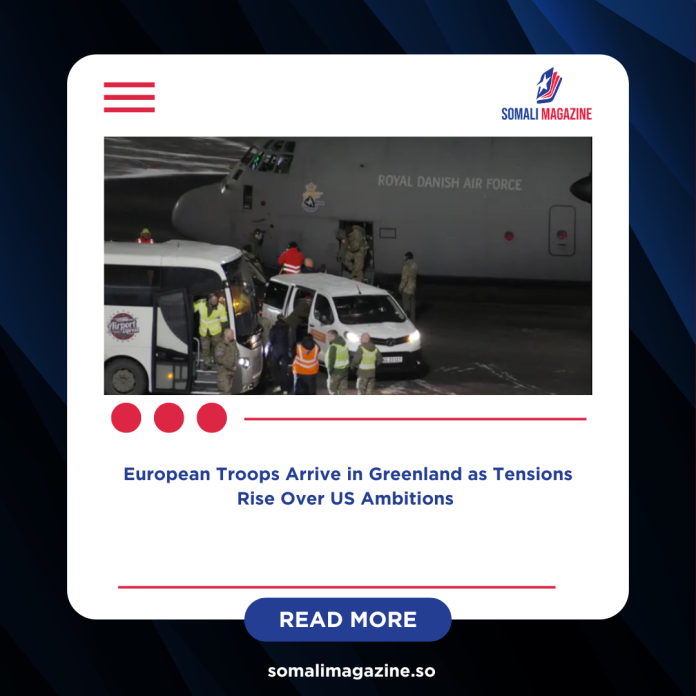
European countries have begun sending troops to Greenland as tensions grow over the future of the Arctic island, following talks that exposed deep disagreements between the United States and its European allies. Soldiers from France, Germany, and other European nations have started arriving in Greenland in what officials describe as a security-focused mission meant to underline Europe’s presence and commitment to the region.
France has already deployed 15 soldiers, while Germany has sent a 13-member reconnaissance team. Norway and Sweden are also taking part. The mission is being described as a short “recognition-of-the-territory” exercise, with a strong symbolic element. European troops are expected to raise the European Union flag in Greenland to signal unity and readiness at a time of growing geopolitical tension in the Arctic.
French President Emmanuel Macron confirmed that French military personnel were already on their way, with more expected to follow. French officials said troops from a mountain infantry unit had arrived in Nuuk, Greenland’s capital. Paris stressed that the two-day mission is meant to demonstrate how quickly European forces can be deployed if the situation requires it.
Germany’s Defence Ministry said its team would focus on assessing conditions on the ground, reflecting what European officials describe as a growing sense of urgency. That concern has intensified after recent US foreign policy actions and repeated statements by President Donald Trump expressing his desire to take control of Greenland.
At the same time, Denmark announced plans to increase its own military presence on the island. This came as Danish and Greenlandic foreign ministers traveled to Washington for talks with senior US officials, including Secretary of State Marco Rubio and Vice President JD Vance. The discussions focused on Greenland’s security and Trump’s stated interest in acquiring the semiautonomous Danish territory, which is rich in mineral resources and strategically located in the Arctic.
The talks ended without any major breakthrough. Danish Foreign Minister Lars Lokke Rasmussen said the US position remained unchanged, noting that Trump continues to express a desire to take over Greenland. Greenland’s Foreign Minister Vivian Motzfeldt said her government supports cooperation with the United States but made it clear that Greenland does not want to be owned by any other country.
Despite limited progress, Denmark and Greenland agreed to set up a working group with the United States to continue discussions on Arctic security and governance. However, the White House signaled that European troop deployments would not influence Trump’s thinking. A spokesperson said the presence of European soldiers would not affect the president’s goal of acquiring Greenland.
Trump has repeatedly argued that the US needs Greenland for security reasons, claiming that without American involvement, Russia or China would move in. He has also criticized Denmark’s ability to defend the territory, dismissing its military presence as weak.
From Nuuk, observers say Denmark is pursuing two goals: convincing Washington that it can take Arctic defense seriously, and creating a form of deterrence. While no one believes European troops could stop a US takeover, their presence would complicate any such move because they come from NATO allies. The situation has created an unusual scenario in which NATO countries appear to be preparing, at least symbolically, to deter pressure from within the alliance itself.
Russia has strongly criticized the developments. Moscow rejected claims that Russian or Chinese activity justifies increased military presence in Greenland, accusing Western countries of inventing threats to legitimize their actions. Russian officials said the situation exposes contradictions in what they call the West’s “rules-based world order” and insisted the Arctic should remain a zone of peace and cooperation. Russian diplomats have also warned that NATO’s growing presence in the Arctic is a cause for serious concern.
Beyond geopolitical rivalries, there is growing anxiety among Greenland’s Indigenous Inuit communities. In towns like Ilulissat, residents fear that foreign interest in Greenland’s mineral wealth could threaten their way of life. Community leaders have expressed concern that decisions are being driven by resource competition rather than respect for the people who have lived on the island for thousands of years. For many Inuit families, the debate is not about global power struggles, but about protecting their land, culture, and future.