
Facebook

Twitter (X)

Instagram

Somali Magazine - People's Magazine
In December, as violence continued to devastate Sudan, the British government once again called for accountability and expressed concern over the large-scale suffering of civilians caught in the war between the Sudanese army and the Rapid Support Forces (RSF). Publicly, the UK has consistently condemned the killing of civilians and warned of the consequences of ongoing atrocities. However, reports suggest that behind closed doors, British officials rejected stronger proposals aimed at preventing mass violence as the conflict intensified.
This gap between public statements and private decisions has raised serious questions about whether the UK’s actions match its rhetoric in the Horn of Africa. Analysts argue that similar contradictions can be seen in Britain’s approach to Somalia and Somaliland, where London officially supports Somalia’s territorial integrity while simultaneously holding a financial stake in a major port located in Somaliland, a self-declared state it does not recognise.
Amgad Fareid Eltayeb, a Sudanese policy analyst, says credibility in international diplomacy is increasingly judged by the risks governments are willing to take. When words and actions do not align, he argues, countries lose their role as neutral mediators and are instead seen as actors protecting their own interests. This perception, analysts say, now shapes how Britain’s role across the region is understood.
In Sudan, internal UK documents previously described London’s strategy as the “least ambitious” option, even as reports of mass killings by the RSF mounted in Darfur. Critics argue that by avoiding stronger diplomatic pressure, the UK has helped shape an international narrative that downplays the scale of RSF abuses. Allegations that the United Arab Emirates has supported or armed the RSF, which Abu Dhabi denies, have further complicated matters. Eltayeb claims the UK has indirectly enabled this dynamic by failing to challenge its close regional partner, allowing atrocities to be softened in diplomatic discussions.
The UK Foreign Office maintains that it is working with allies to end the violence in Sudan and push both sides toward a ceasefire, humanitarian access, and a transition to civilian rule. However, it declined to comment on questions related to Somalia or its commercial involvement in Somaliland.
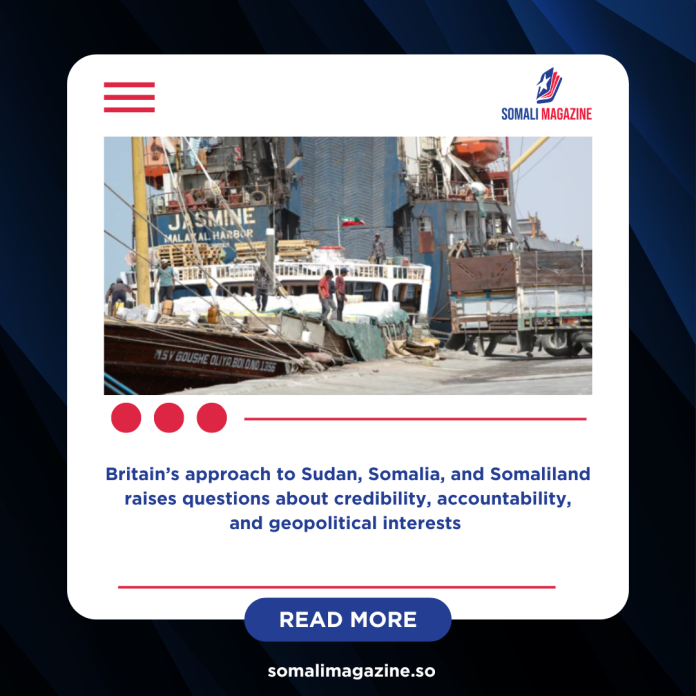
At the centre of this debate is the port of Berbera, located along a key maritime corridor linking the Red Sea and the Indian Ocean. The port is jointly owned by the Somaliland government, the UAE-based firm DP World, and British International Investment, the UK government’s development finance arm. Despite not recognising Somaliland, Britain’s financial stake gives it a significant presence in an area with major geopolitical importance.
Historians note that Berbera has long been treated by outside powers as a strategic asset rather than a political community, serving at various times as a British base, a Soviet naval facility, and now a logistics hub shaped by Gulf and Western interests. Today, critics argue that the port may be part of a broader regional logistics network that UN experts and media have linked to alleged supply routes for the RSF, allegations the UAE strongly denies.
For analysts, this creates a perception problem. While the UK calls for accountability in Sudan, it remains economically linked to infrastructure operated by a country accused of supporting one side in the conflict. Even if London disputes these connections, critics say the optics undermine its moral authority.
The issue has become even more sensitive as Somaliland’s political status gains renewed attention following Israel’s recent decision to recognise its independence, a move rejected by Somalia and most of the international community. Analysts stress that in such contexts, major infrastructure investments cannot be separated from politics. Ports, they argue, are not neutral assets but centres of power that influence security, revenue, and political legitimacy.
Britain’s approach has been described as a “dual-track” policy: maintaining formal support for Somalia while engaging Somaliland as a functioning authority. While this strategy offers flexibility and access, experts warn it may weaken accountability on both sides and delay meaningful political solutions.
Taken together, critics say the UK’s actions in Sudan and Somalia reflect a broader pattern of preserving partnerships and access while avoiding hard choices. In a region where conflicts, alliances, and economic interests are deeply intertwined, analysts caution that such ambiguity may deliver short-term influence but risks long-term damage to Britain’s credibility and ability to promote genuine political compromise.