
Facebook

Twitter (X)

Instagram

Somali Magazine - People's Magazine
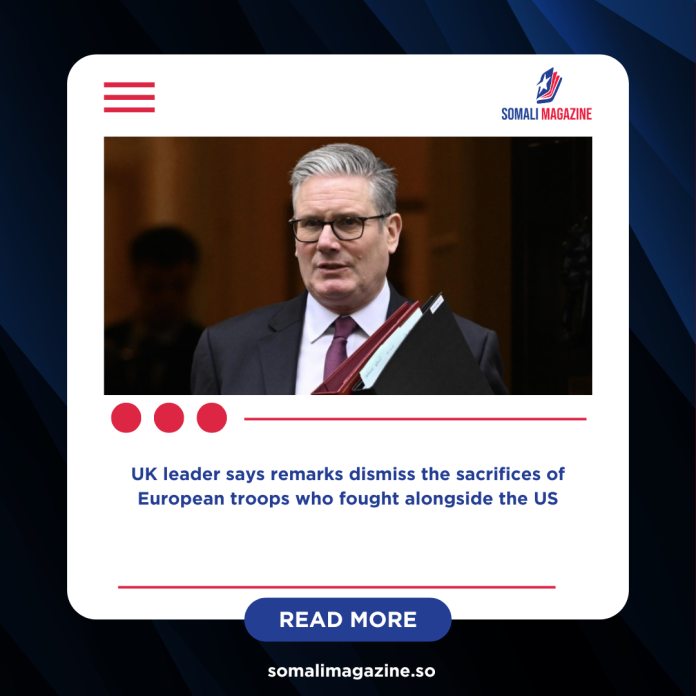
British Prime Minister Keir Starmer has sharply criticised former US President Donald Trump over comments that appeared to downplay the role of European troops in the war in Afghanistan, saying the remarks were deeply disrespectful to those who fought and died alongside American forces. Starmer said Trump should apologise for suggesting that NATO allies stayed “a little off the front lines” during the conflict, calling the statement insulting and unacceptable.
Speaking on Friday, Starmer said that if he had spoken in such a way about the sacrifices of allied troops, he would feel a clear responsibility to say sorry. He stressed that the comments ignored the reality of what happened on the ground in Afghanistan and the heavy price paid by many countries, including the United Kingdom. He paid tribute to the 457 British service members who lost their lives after the UK joined the US-led invasion in 2001, which followed the September 11 attacks in the United States.
The UK was one of the largest contributors to the war effort in Afghanistan. Over 150,000 British military personnel served there over the course of the conflict, making Britain second only to the United States in terms of troop numbers. British forces were involved in some of the most dangerous operations, particularly in Helmand province, where fighting was intense and casualties were high. For many in the UK, Trump’s remarks were seen as dismissing years of sacrifice made by soldiers and their families.
Other European nations also suffered significant losses. More than 150 Canadian soldiers were killed during the war, along with around 90 French troops and dozens from countries such as Germany and Italy. Denmark, which has recently faced political pressure from Trump over Greenland, lost 44 soldiers. These losses occurred after NATO’s collective defence clause, known as Article 5, was triggered for the first time in the alliance’s history following the 9/11 attacks, bringing allied forces together in support of the United States.
The United States itself paid a heavy price, losing more than 2,400 soldiers during the conflict. Beyond military casualties, the human cost for Afghanistan was devastating. Estimates suggest that at least 46,000 Afghan civilians died as a direct result of the invasion, with many more suffering indirectly due to displacement, lack of healthcare, food shortages and damaged infrastructure. These figures underline the scale and seriousness of the war, making comments that minimise allied involvement particularly painful for those affected.
Trump’s remarks came during a tense period in relations between the US and Europe. Earlier in the week, he had threatened to impose tariffs on several European countries and raised controversial ideas about US control over Greenland, a semi-autonomous territory of Denmark. Although he later softened his position after discussions with NATO leaders, his comments about Afghanistan struck a nerve across the continent and reignited concerns about the future of transatlantic cooperation and trust within NATO.
European leaders were quick to respond. The White House defended Trump, insisting that the United States had done more for NATO than all other members combined. However, officials across Europe rejected this view. The Dutch foreign minister described the remarks as untrue and disrespectful, while Poland’s defence minister reaffirmed his country’s commitment as a loyal and proven ally. Their responses reflected a broader sense of frustration with statements that appeared to rewrite shared history.
In the UK, the reaction went beyond politics. Prince Harry, who served two tours of duty in Afghanistan with the British Army, spoke out about the importance of honesty and respect when discussing the war. He reminded the public that thousands of lives were permanently changed, with families grieving lost sons and daughters and children growing up without parents. His words echoed the feelings of many veterans and families who believe the sacrifices made in Afghanistan should never be ignored or minimised.