
Facebook

Twitter (X)

Instagram

Somali Magazine - People's Magazine
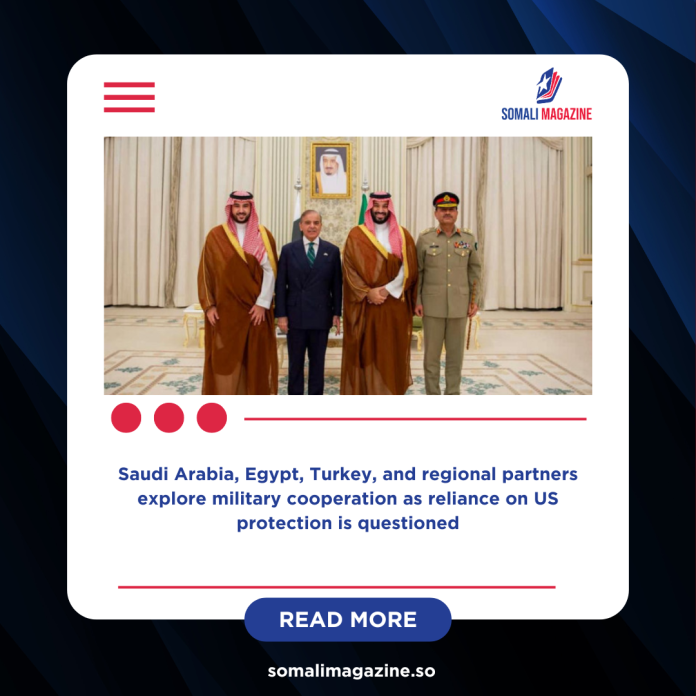
Political alliances and security partnerships across the Middle East are shifting as regional powers look for new ways to protect their interests in a changing global environment. Recent diplomatic meetings and defense talks suggest that countries such as Saudi Arabia, Egypt, Turkey, Pakistan, Somalia, and the United Arab Emirates are exploring closer military cooperation, driven largely by uncertainty over long-term reliance on the United States.
Earlier this week, Saudi Arabia’s Foreign Minister Prince Faisal bin Farhan met Egypt’s Foreign Minister Badr Abdelatty during the World Economic Forum in Davos. Officially, the talks focused on issues of mutual concern, but the timing and context point to deeper discussions around regional security. Both Saudi Arabia and Egypt have accepted invitations to join US President Donald Trump’s proposed “Board of Peace,” and there is growing speculation that the two countries are also finalizing details of a new defense agreement.
At the same time, Somali President Hassan Sheikh Mohamud is expected to travel to Saudi Arabia to sign a separate defense deal with Riyadh. If Somalia becomes part of a broader security arrangement involving Saudi Arabia and Egypt, it would significantly strengthen their influence along the Bab el-Mandeb Strait. This narrow but vital shipping route links the Red Sea to the Gulf of Aden and the Indian Ocean, making it one of the most strategically important waterways in the world for global trade and energy transport.
Beyond Africa and the Arab world, Turkey is also emerging as a key player in these evolving security plans. Reports indicate that Ankara is interested in joining a defense agreement already signed between Saudi Arabia and Pakistan in 2024. Some commentators have labeled the idea of a Saudi-Pakistan-Turkey alliance as an “Islamic NATO,” suggesting it could combine Pakistan’s nuclear capabilities, Saudi Arabia’s financial power, and Turkey’s military strength. Supporters of this view argue that such a bloc could reshape security dynamics from the eastern Mediterranean to the Indian Ocean.
However, not all experts agree with this dramatic interpretation. Analysts point out that Saudi Arabia’s push for new defense partnerships is less about forming an ideological alliance and more about reducing dependence on the United States. In recent years, many Gulf states have questioned Washington’s willingness to intervene decisively in regional crises. Past incidents, such as attacks on Saudi oil facilities and tensions involving close US allies, have reinforced the perception that American security guarantees are no longer as reliable as they once were.
At the same time, divisions within the Gulf itself are becoming more visible. Relations between Saudi Arabia and the United Arab Emirates have been strained by their support for rival factions in conflicts such as Sudan and Yemen. Saudi airstrikes in Yemen against UAE-backed forces and reports of competing arms deals in Sudan highlight how strategic interests between the two neighbors do not always align.
The UAE, meanwhile, has been pursuing its own defense and energy partnerships beyond the Gulf. A recent comprehensive agreement with India has strengthened ties in liquefied natural gas supply and nuclear cooperation. This move is widely seen as a political signal as much as a military or economic one, showing that Abu Dhabi maintains strong global partnerships independent of Saudi Arabia.
Despite these tensions, most observers believe a serious break between Saudi Arabia and the UAE remains unlikely. Both countries remain closely connected to the United States and are involved in Trump’s diplomatic initiatives. Turkey, another potential security partner for Saudi Arabia, also maintains strong relations with the UAE, further limiting the chances of a deep regional split.
Ultimately, while new defense agreements may slightly shift regional balances, their impact should not be overstated. Differences in political priorities, ideology, and national interests continue to limit how far these alliances can go. Rather than forming a unified military bloc, Middle Eastern powers appear to be focused on gaining more autonomy, access to advanced military technology, and greater flexibility in an increasingly uncertain global order.