
Facebook

Twitter (X)

Instagram

Somali Magazine - People's Magazine
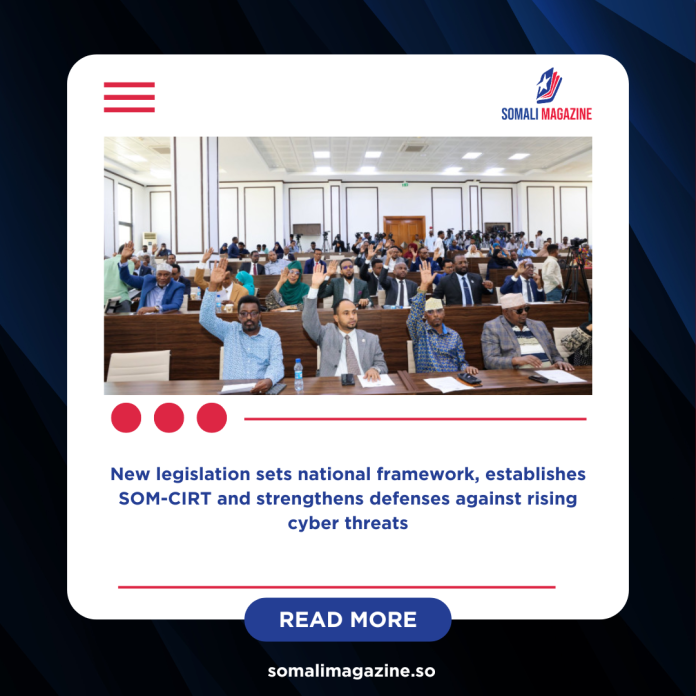
Somalia’s lower house of parliament has approved a new Cybersecurity Law aimed at protecting the country’s growing digital infrastructure and strengthening defenses against cyber threats. The legislation, passed on Saturday, is seen by officials as a timely response to the rapid expansion of digital services across Somalia, alongside rising risks of cybercrime, data breaches and disruptions targeting both government and private-sector systems.
The new law establishes a clear national framework for managing cybersecurity and sets out how cyber risks should be prevented, reported and addressed. It defines the roles and responsibilities of key institutions to ensure better coordination and accountability in protecting digital systems. Under the legislation, the Ministry of Communications and Technology is tasked with overall policy leadership, while the National Communications Authority is given technical oversight responsibilities. Operators of critical infrastructure, including telecommunications and other essential service providers, are also required to meet specific legal obligations to secure their systems and report cyber incidents.
One of the most significant elements of the law is the formal creation of the Somalia Computer Incident Response Team, known as SOM-CIRT. This national body will be responsible for coordinating responses to cyberattacks and other digital security incidents. SOM-CIRT is expected to act as a central point for monitoring threats, sharing information, and supporting both public and private institutions during cyber emergencies. Officials believe this will greatly improve Somalia’s ability to detect attacks early and respond in a coordinated and effective manner.
Speaking after the approval, Mustafa Yasin Sheikh, the director general of the National Communications Authority, described the law as an important milestone in building a unified cybersecurity system. He said it would enhance Somalia’s preparedness to deal with digital threats and help the country move away from fragmented and reactive responses toward a more structured and proactive approach. According to him, the law sends a strong message that cybersecurity is now a national priority.
State Minister of Communications and Technology Ahmed Osman Dirie also welcomed the vote, thanking members of parliament for their support. He emphasized that the law is a critical pillar for safeguarding national security and protecting citizens as Somalia becomes increasingly dependent on digital technologies. Dirie noted that the legislation aligns Somalia more closely with international standards and best practices in cybersecurity governance, which is essential for building confidence among investors, partners and service users.
The approval of the Cybersecurity Law comes at a time when Somalia is rapidly expanding digital services such as e-government platforms, mobile money systems and digital identification programs. While these developments have improved access to services and boosted economic activity, they have also increased exposure to cyber risks. Weak protections can leave systems vulnerable to hacking, fraud and service disruptions, with serious consequences for public trust and economic stability. Officials say the new law addresses these concerns by setting minimum security requirements and encouraging closer cooperation between government agencies, private companies and international partners.
Beyond security, the law is expected to support the growth of Somalia’s digital economy by building trust in online services. Stronger cybersecurity measures can encourage innovation, attract investment and make it safer for businesses and citizens to operate online. For international partners, the legislation provides a clearer framework for cooperation and assistance in strengthening Somalia’s digital resilience.
For a country emerging from decades of conflict and institutional fragility, leaders say the Cybersecurity Law lays an important foundation for protecting the digital space that now underpins daily life, commerce and public administration. As Somalia continues its digital transformation, the law is expected to play a key role in ensuring that technological progress is matched with the safeguards needed to protect national interests and the public.