
Facebook

Twitter (X)

Instagram

Somali Magazine - People's Magazine
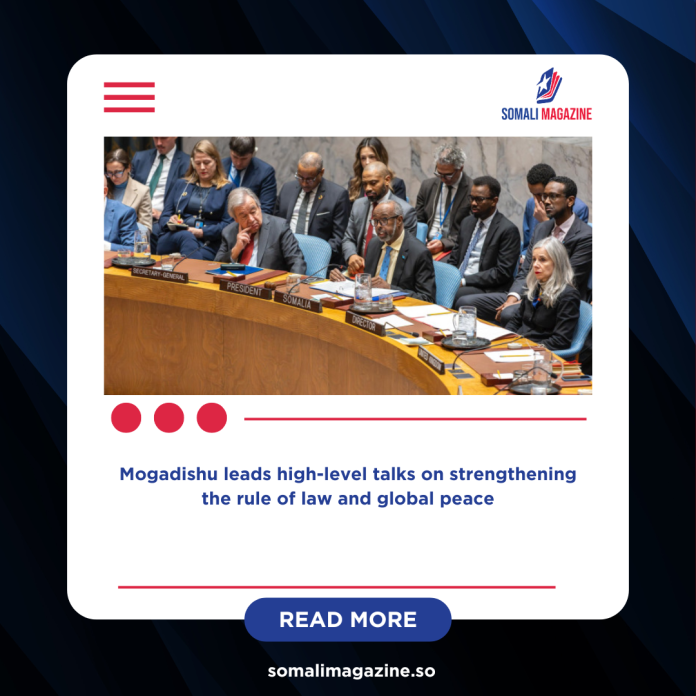
Somalia marked a historic milestone on Monday as it presided over the United Nations Security Council for the first time in more than five decades, leading a high-level meeting focused on promoting the rule of law as a foundation for international peace and security. The session symbolized Somalia’s renewed engagement on the global stage and its growing role in multilateral diplomacy after years of conflict and instability.
The meeting was originally expected to be chaired by Somali President Hassan Sheikh Mohamud, who had planned to travel to New York for the occasion. However, his trip was cancelled due to severe weather conditions in the United States that disrupted travel plans. In his absence, Somalia’s Permanent Representative to the United Nations, Ambassador Abukar Dahir Osman Baale, took on the responsibility of chairing the session on behalf of the country.
Held under the agenda item “The promotion and strengthening of the rule of law in the maintenance of international peace and security,” the meeting brought together senior UN officials, diplomats, and legal experts to discuss how international law can be better upheld in a world facing growing conflict, political tension, and humanitarian crises. Somalia’s Permanent Mission to the United Nations described the moment as historic, noting that it was the country’s first time presiding over the Security Council since 1972.
In its statement, the Somali mission emphasized the importance of renewing global commitment to the principles of the UN Charter. It called on member states to move beyond rhetoric and take real, practical action to uphold the rule of law at both national and international levels. The statement stressed that strengthening respect for international law is essential not only for resolving conflicts but also for safeguarding the rights and dignity of people worldwide, including future generations.
The session featured briefings from several high-profile figures. UN Secretary-General António Guterres addressed the Council, highlighting the central role of the rule of law in preventing conflict, protecting civilians, and ensuring accountability. He underscored that international law must be applied consistently and fairly, without double standards, if it is to maintain credibility and effectiveness. Guterres also warned that selective application of the law weakens trust in global institutions and fuels instability.
African Union Commission Chairperson Mahmoud Ali Youssouf also spoke at the meeting, bringing a regional perspective to the discussion. He emphasized the importance of cooperation between the United Nations and regional organizations, particularly in Africa, where peace and security challenges often require coordinated responses. He noted that strong legal frameworks and respect for international norms are essential for sustainable peace on the continent.
Abdulqawi Yusuf, a former judge at the International Court of Justice, provided a legal expert’s perspective on the challenges facing the international rule of law. He spoke about the need for stronger institutions, greater political will, and better enforcement mechanisms to ensure that international legal decisions are respected and implemented. His remarks highlighted the gap that often exists between international legal principles and their application in real-world situations.
During the discussion, many speakers reflected on the role of the Security Council itself in upholding international law. Several member states called on the Council to fully carry out its responsibilities under the UN Charter and to take decisive action when international law is violated. There were also renewed calls for reform of the Security Council to make it more representative, transparent, and effective in addressing today’s global challenges.
According to a concept note prepared by Somalia, the main goal of the meeting was to reaffirm the importance of the international rule of law in maintaining peace and security, while also identifying practical steps to strengthen it. Somalia emphasized that respect for international law should not be optional, but a shared responsibility of all nations.
Somalia is holding the rotating presidency of the UN Security Council for January 2026, a role that marks its return to a position of global leadership after decades of absence. Throughout the month, Ambassador Abukar Dahir Osman Baale is presiding over Council activities, with a stated focus on reinforcing multilateral cooperation and respect for international law. For Somalia, the moment represents both a symbolic achievement and an opportunity to contribute meaningfully to global peace and security discussions.