Facebook

Twitter (X)

Instagram

Somali Magazine - People's Magazine
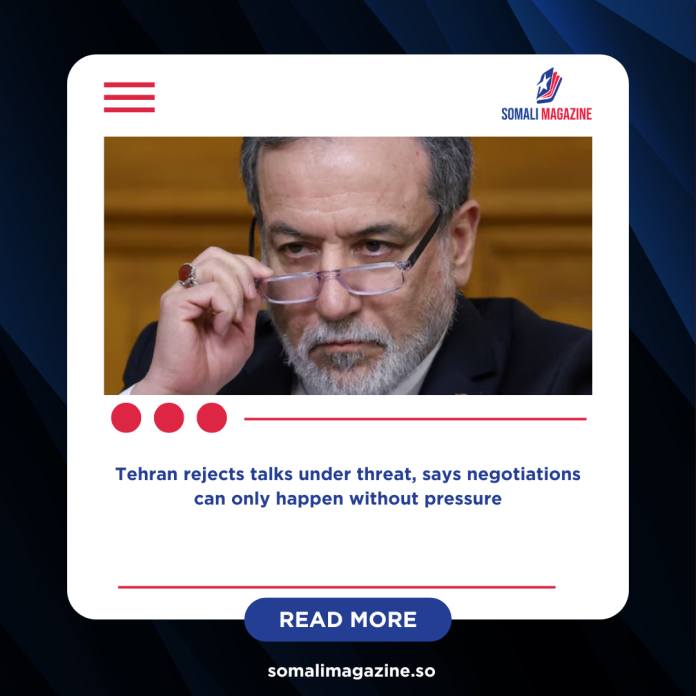
Iran’s Foreign Minister Abbas Araqchi has firmly dismissed claims that Tehran has recently been in contact with the United States or has asked for negotiations. Speaking to state media on Wednesday, Araqchi said there had been no communication between him and U.S. special envoy Steve Witkoff in recent days, and no request for talks had been made by Iran. His remarks come amid rising tensions between Washington and Tehran, fueled by strong statements from U.S. President Donald Trump and increased American military activity in the region.
On Tuesday, President Trump said another U.S. “armada” was moving toward Iran, a comment that added to concerns about a possible escalation. While expressing hope that Iran would agree to make a deal with Washington, Trump’s language was widely interpreted as a show of military pressure rather than a diplomatic overture. The remarks followed reports that the United States had deployed additional military assets to the Gulf, citing security concerns after widespread protests in Iran.
Those protests, which spread across the country, were met with a heavy crackdown by Iranian authorities. According to multiple reports, the response marked the bloodiest suppression of unrest since Iran’s 1979 Islamic Revolution. The unrest and the government’s response have further complicated Iran’s already tense relationship with the United States and its allies, particularly at a time when the region remains highly sensitive to military movements and political statements.
Araqchi emphasized that Iran’s position on negotiations has not changed. He said that while there had been no direct contact with U.S. officials, several intermediaries were involved in ongoing discussions and consultations. These intermediaries, he explained, remain in touch with Tehran and are exploring possible ways to reduce tensions. However, he was clear that such efforts do not amount to formal negotiations and should not be interpreted as a willingness to engage under pressure.
“Our stance is clear,” Araqchi said. “Negotiations do not go hand in hand with threats.” He added that talks could only happen in an environment free from intimidation, excessive demands, and military pressure. According to him, diplomacy must be based on mutual respect and adherence to international norms, not coercion. This message appeared to be a direct response to Trump’s comments and the visible buildup of U.S. forces in nearby waters.
Iranian officials have repeatedly argued that threats and sanctions undermine trust and make meaningful dialogue impossible. Araqchi’s statement reinforced this view, suggesting that while Iran does not reject diplomacy outright, it will not engage in talks that it believes are designed to force concessions rather than reach fair agreements.
Meanwhile, Iran’s President Masoud Pezeshkian struck a slightly more conciliatory tone in a phone call with Saudi Arabia’s Crown Prince Mohammed bin Salman on Tuesday. During the conversation, Pezeshkian said Iran welcomes any process that can prevent war, as long as it operates within the framework of international law. His comments indicated that Tehran remains open to regional and international efforts aimed at de-escalation, even as it resists direct negotiations under threat.
The exchange highlights the complex dynamics currently shaping Iran’s foreign relations. On one hand, Iranian leaders are pushing back strongly against what they see as U.S. intimidation. On the other, they are signaling to regional partners that they support peaceful solutions and mechanisms that reduce the risk of conflict. With military movements continuing and rhetoric on both sides remaining sharp, the situation remains tense, and the path toward dialogue appears uncertain.