
Facebook

Twitter (X)

Instagram

Somali Magazine - People's Magazine
The United States Africa Command (AFRICOM) has defended its increased airstrikes in Somalia, saying the operations are playing a critical role in supporting Somali forces fighting extremist groups, particularly ISIS-linked militants in the country’s northeast.
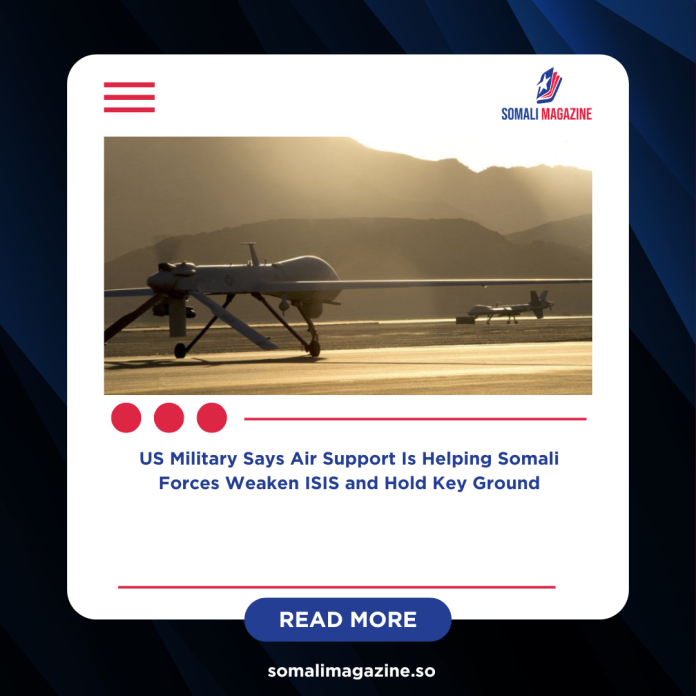
Speaking during a digital press briefing, AFRICOM Commander General Dagvin Anderson said the airstrikes are carefully coordinated with Somali partner forces and are meant to provide support in areas where local troops face limitations. These include advanced intelligence gathering, surveillance, and precision targeting, capabilities that Somali forces do not yet fully possess on their own.
General Anderson pointed to recent military operations in the Golis Mountains in Puntland as a clear example of how U.S. support has made a difference. The mountainous terrain has long been used by ISIS elements as a hiding place and operational base. According to Anderson, Somali forces, backed by U.S. air support and intelligence, launched a sustained offensive that significantly reduced the group’s ability to operate freely in the area.
He said the airstrikes helped Somali troops remain engaged on the ground, maintain pressure on militants, and steadily shrink the territory under ISIS influence. Feedback from Somali partners, he added, shows that the continued operations have disrupted militant movements and forced ISIS leaders to go into hiding, making it harder for them to plan attacks or move openly.
AFRICOM officials emphasized that airstrikes are only one part of a wider security partnership with Somalia. The broader effort includes training, intelligence sharing, logistical assistance, and long-term capacity building aimed at strengthening Somali security institutions.
Sergeant Major Garric M. Banfield, AFRICOM’s Command Senior Enlisted Leader, highlighted ongoing efforts to improve maritime security along Somalia’s coastline. He said the U.S. is providing technical support to help Somali authorities better monitor their territorial waters and address threats such as arms smuggling, piracy, and illegal fishing.
According to Banfield, improving maritime domain awareness is essential for protecting Somalia’s borders and coastal communities. Smuggling routes along the coast, he noted, often fuel armed groups by allowing weapons and other illicit supplies to reach militant networks operating on land.
AFRICOM leaders also linked Somalia’s maritime security to wider regional stability, particularly in the Gulf of Aden and the Red Sea. They warned that insecurity in Somali waters can have ripple effects across the region, empowering criminal and extremist networks that exploit weak enforcement and porous borders.
General Anderson described Somalia as a key battleground in the wider fight against extremist organizations in Africa, including al-Shabaab and ISIS affiliates. He stressed, however, that U.S. involvement is designed to support Somali-led efforts rather than replace them.
“Somali forces are the ones conducting ground operations,” Anderson said, explaining that U.S. assistance focuses on enabling those operations through intelligence, training, logistics, and targeted air support when needed.
AFRICOM officials argue that this partnership approach allows Somali forces to keep momentum against militants while steadily building the skills and systems required for long-term security. The goal, they say, is for Somalia to eventually handle these threats independently.
Throughout the briefing, AFRICOM leadership repeatedly connected security gains to broader goals such as stability, governance, and economic development. Anderson noted that improved security creates space for communities to rebuild, access services, and pursue economic opportunities.
“Security leads to stability, and that stability creates opportunities,” he said, adding that close cooperation with African partners remains at the core of AFRICOM’s strategy on the continent.