
Facebook

Twitter (X)

Instagram

Somali Magazine - People's Magazine
Hundreds of pastoralist families who lost their livestock to prolonged drought are now struggling to survive in and around Lasanod town in Somalia’s Sool region. After two consecutive failed rainy seasons destroyed pasture and water sources, many families were forced to leave their villages in December and move to Lasanod in search of help.
Most of the displaced families depended entirely on livestock for food and income. When their animals died, they lost everything. Some families are staying with relatives in town, while others have settled in Gooja-ade displacement camp, where there are no proper services such as water points, schools, or health facilities.
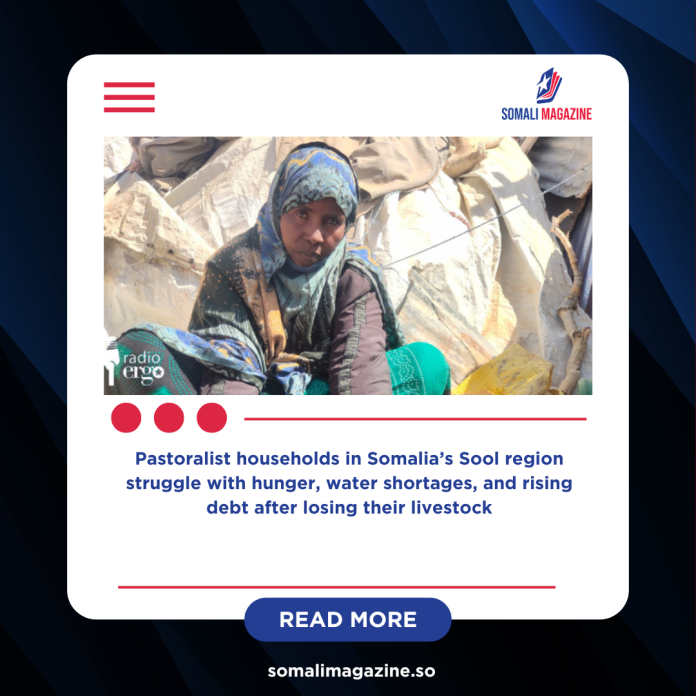
Asho Mohamud Jama, a mother of 12, says life has become a daily struggle. With no income, she spends hours walking around Lasanod asking for food and small donations. Some days she returns with a little, other days with nothing. At best, she says, she can get one kilogram of food, which is not enough to feed her large family.
Her youngest child is only 10 months old. Her husband has been searching for casual work, including carrying goods in town, but has not found any steady job. The family now depends on small loans from local shops and the kindness of strangers.
Water is one of their biggest challenges. Asho walks about seven kilometres to a privately owned borehole to collect a single jerrycan of water each day, which she carries back to the camp on her back. The journey is exhausting, but she says they have no other choice.
The family lives in an old, damaged metal structure that offers little protection from the heat during the day and the cold at night. Her children are still weak after walking for two days from their village, about 30 kilometres away.
Before displacement, four of her children were attending Koranic school. Now, there is no school in the camp, and formal schools in Lasanod cost $15 per child per month, which she cannot afford. Education is no longer a priority when the family is struggling just to eat.
Asho also carries heavy debt from before they fled their village. She owes around $500 to shopkeepers for food and supplies bought on credit. She says the family once lived a stable life, with milk and meat from their animals. Last year alone, they lost 180 out of 200 goats due to lack of water and pasture. The 20 remaining goats are weak, and she fears they will not survive because the family cannot afford feed or water for them.
Ibado Jama Guled, another displaced mother, shares a similar story. She fled Qura-dhere village with her family of seven after losing most of their livestock. Now, they manage to cook only once a day, and sometimes they go without food entirely. She says they lack water, food, and education, and feel they have nothing left.
Ibado has tried to find manual labour in Lasanod, but without connections in the town, it has been difficult. Her family cannot afford the $4 charged for a barrel of water delivered by donkey cart, so they borrow small amounts from neighbours in the camp.
Three of her children, who were previously studying, are now at home with no access to education. She also owes about $1,000 to shopkeepers for supplies taken on credit before displacement. The stress of debt keeps her awake at night, worrying about how she will repay it. Most of her remaining goats are still in the rural area with her husband, and she doubts they will survive without water and pasture.
Local authorities say nearly 200 drought-displaced families have been registered in Lasanod since December. The mayor, Boos Dubad Boos, said the families are living in extremely harsh conditions, lacking basic services such as water, shelter, sanitation, and healthcare. Poor sanitation and the absence of latrines are also raising health concerns.
The mayor said the situation has been reported to government institutions and humanitarian agencies, but so far no assistance has arrived. Meanwhile, families like Asho’s and Ibado’s continue to struggle each day, with little hope of returning home as long as the drought persists and their livestock are gone.