Facebook

Twitter (X)

Instagram

Somali Magazine - People's Magazine
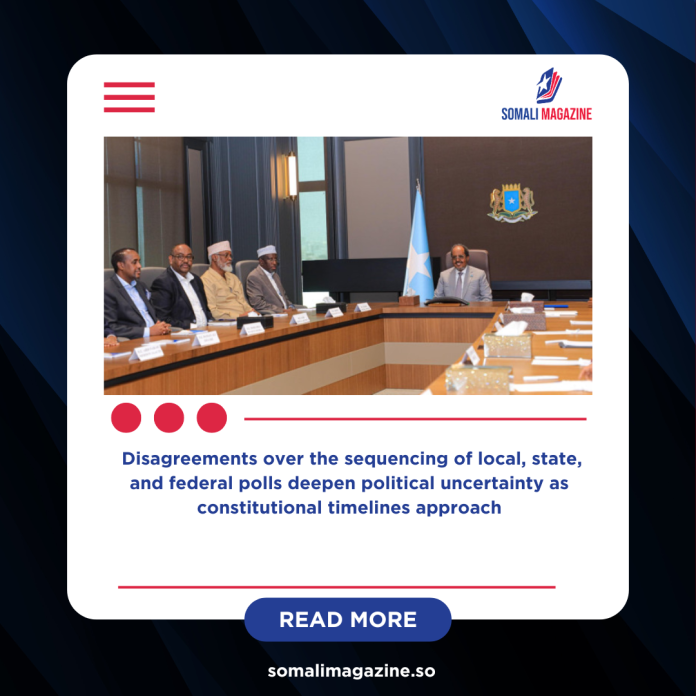
High-level talks between Somalia’s federal government and the opposition-aligned Somali Future Council ended on Sunday without any agreement, highlighting ongoing political tensions over the country’s election plans.
The meeting took place at Villa Somalia and was chaired by President Hassan Sheikh Mohamud. It began at around 11 a.m. and lasted until approximately 4 p.m. While the atmosphere was calm at the start, discussions reportedly became tense once leaders began debating how the upcoming elections should be organized and in what order they should be held.
According to participants familiar with the discussions, President Hassan Sheikh Mohamud made it clear that federal-level elections should not be discussed until local council elections are conducted first. He stressed that the process must begin at the grassroots level before moving to state and national polls. The president also declined to open discussions about elections in Galmudug, Hirshabelle, and Southwest states during the session.
The opposition, under the Somali Future Council, has been pushing for indirect elections in those three states. They argue that a similar model was recently used in Puntland and Jubbaland and could provide a workable path forward. Indirect elections typically involve delegates or representatives choosing leaders rather than a direct public vote. The opposition believes this approach could help prevent delays and political uncertainty.
However, President Hassan Sheikh Mohamud reportedly maintained that the responsibility for managing elections in Galmudug, Hirshabelle, and Southwest lies with their respective state leadership. He indicated that the federal government would not override or interfere with those state-level processes. This position created a major point of disagreement between the two sides.
After several hours of debate, the meeting paused briefly to allow for consultations. Hopes that the break would ease tensions and lead to compromise did not materialize. When talks resumed, the gap between the government and the opposition remained wide. Eventually, the meeting ended without a joint statement, agreement, or clear roadmap.
Following the adjournment, members of the Somali Future Council returned to their headquarters. They are expected to hold internal discussions to decide their next steps. A public statement outlining their position is anticipated. Meanwhile, the federal government has not issued detailed comments about the meeting’s outcome, though officials have indicated that dialogue could continue in the future.
The failure to reach an agreement has disappointed many observers who had hoped the talks would reduce political tensions. Somalia is approaching important constitutional timelines, and unresolved disputes over elections could create uncertainty. The main issue remains the order in which local, state, and federal elections should take place.
With mandates nearing expiration, pressure is mounting on both the federal government and the opposition to find common ground. Without a clear and mutually accepted electoral roadmap, the risk of prolonged political standoff increases. Many citizens and political analysts believe that continued dialogue will be essential to prevent instability and ensure a smooth transition when election time arrives.
For now, the talks have ended without progress, leaving key questions unanswered about how and when Somalia’s next elections will be conducted. Both sides face growing expectations from the public and the international community to return to the negotiating table and reach a workable compromise.