Facebook

Twitter (X)

Instagram

Somali Magazine - People's Magazine
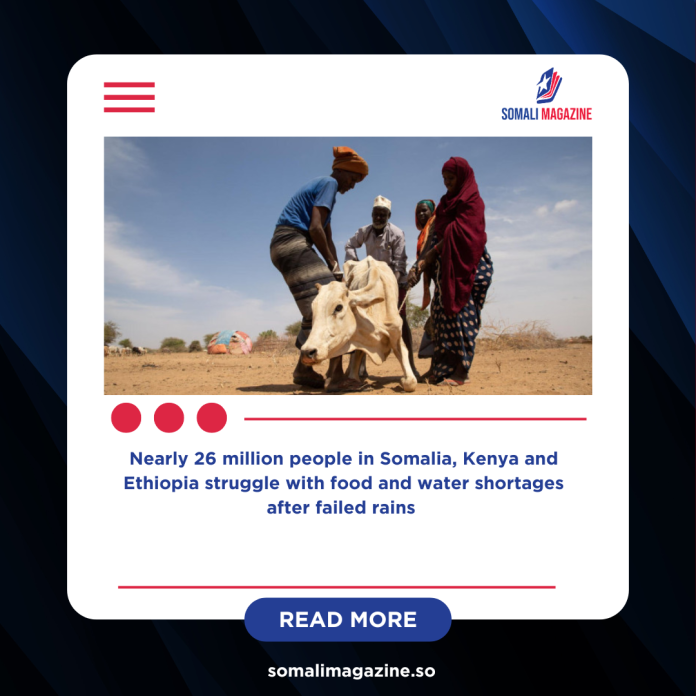
Millions of people across the Horn of Africa are facing a worsening drought crisis after seasonal rains failed across large parts of Somalia, Kenya and Ethiopia. According to a new report released by Oxfam this week, nearly 26 million people across the three countries are now experiencing extreme hunger as food and water shortages grow more severe.
The crisis follows the failure of the October to December rainy season, which many communities depend on for farming, livestock grazing and water supplies. The situation is especially alarming because people in the region are still recovering from the longest and harshest drought in recent history, which lasted from 2020 to 2023 and saw five rainy seasons fail in a row. That earlier drought devastated farms, wiped out livestock and left millions struggling to rebuild their lives.
Today, many communities are once again facing dry wells, failed crops and rising food prices. Livestock, which are the main source of income for pastoralist families, are dying in large numbers due to lack of water and pasture. As animals weaken and die, families lose both food and income, pushing them deeper into poverty and hunger.
Water has become one of the most urgent challenges. In some of the hardest-hit areas of Somalia, water prices have skyrocketed by more than 2,000 percent. Families who once paid about $0.06 for a 20-liter jerrycan of water now pay between $1 and $1.50. For households that have already lost crops and animals, these prices are simply unaffordable.
In Hobyo town, located north of Mogadishu, residents depend on water delivered by trucks from villages about 30 kilometers away. The long distance and high transport costs have pushed water prices even higher, making it difficult for many families to meet their daily needs.
Oxfam’s Africa Director, Fati N’Zi-Hassane, warned that water trucking is becoming the last option for many communities. However, families who cannot afford even one meal a day for their children also struggle to pay for water. She said women and girls are often the most affected, as they are usually responsible for collecting water. Many now walk up to 15 kilometers in search of water, often facing dangerous and unsafe conditions along the way.
The growing water shortage is also forcing people to leave their homes in search of better living conditions. Across the region, more than 58 million people are currently without reliable access to clean water.
In Somalia alone, the latest Integrated Food Security Phase Classification (IPC) assessment shows that about 6.5 million people — nearly one in three Somalis — are expected to face crisis-level hunger between February and March 2026. The situation for children is particularly worrying. Acute malnutrition rates have more than doubled, and experts estimate that around 1.84 million children under the age of five could suffer from acute malnutrition next year.
Other countries in the region are also feeling the impact. In Kenya, farmers in arid and semi-arid areas are reporting poor harvests due to lack of rain. In Ethiopia, repeated failed rainy seasons have reduced crop production by between 34 and 54 percent in some areas, according to food security analysts at FEWS NET.
Humanitarian agencies estimate that between 24.5 million and 25.9 million people across Somalia, Kenya and Ethiopia will need food assistance by the middle of 2026.
The death of livestock is another major concern. In Somalia alone, about 1.4 million animals died in 2025, and another 2.5 million are at risk if the drought continues. In northern Kenya, milk production has dropped by more than half because many animals are either starving or dying from disease. In Ethiopia, weakened livestock are also reducing families’ ability to recover from the drought.
Despite the growing emergency, humanitarian funding for the region has dropped sharply. In 2021, Somalia, Kenya and Ethiopia needed about $2.65 billion in humanitarian aid, and slightly less than 61 percent of that amount was funded. By 2025, however, less than one-third of the required aid had been provided.
Somalia’s humanitarian response plan for 2025 received only 29 percent of the funding it needed, while the 2026 plan has secured just 13.4 percent so far.
N’Zi-Hassane warned that the upcoming dry season could push already struggling communities beyond recovery if urgent help is not provided. She stressed that people in the region have contributed very little to the global climate crisis but are suffering some of its worst consequences.
Aid groups, including Oxfam and its local partners, are currently providing emergency assistance across the three countries. Their efforts include delivering clean water, hygiene supplies, cash assistance and protection services to communities that are hardest to reach and most severely affected by the drought.