
Facebook

Twitter (X)

Instagram

Somali Magazine - People's Magazine
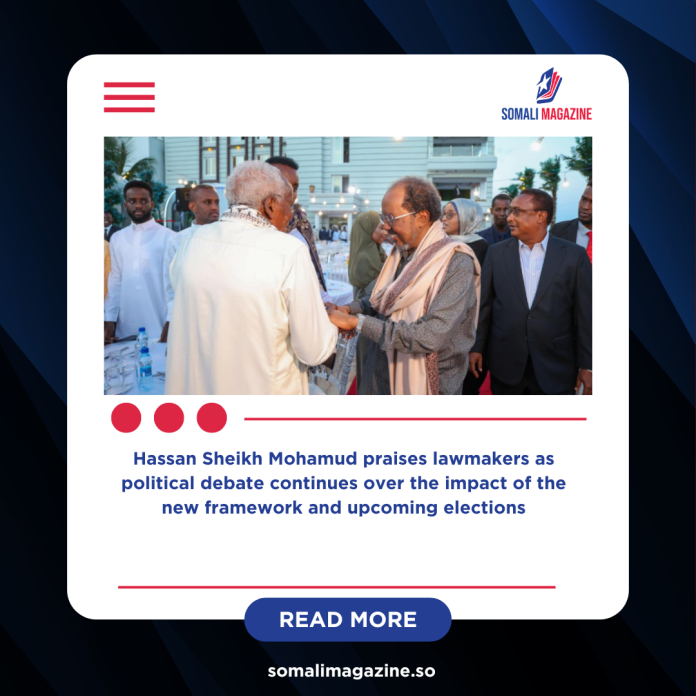
Somali President Hassan Sheikh Mohamud hosted an iftar dinner in Mogadishu on Thursday for members of both houses of parliament, congratulating them for approving the country’s revised constitution after months of intense political debate. The dinner, held at a hotel in Mogadishu, brought together lawmakers and government officials to mark what the president described as an important milestone in Somalia’s long constitutional reform journey.
The gathering came just one day after Somalia’s bicameral parliament voted to adopt constitutional amendments that complete a review process that has been ongoing for more than a decade. The changes formally replace the provisional constitution that had been in place since 2012, when the country was emerging from its transitional political period. Officials say the new constitutional framework is meant to strengthen governance, clarify the structure of the federal system, and provide a stronger legal foundation for the country’s institutions.
Speaking during the iftar event, President Mohamud praised lawmakers for their patience and cooperation throughout the process. He described the approval of the revised constitution as a historic moment for Somalia’s political development and its efforts to build stable state institutions. According to a statement released by the presidency, the president said the new constitution would play a key role in shaping Somalia’s future by supporting democratic governance and protecting the rights of citizens.
He emphasized that the updated constitution will serve as the backbone for building stronger government institutions and ensuring that the country operates under the rule of law. Mohamud also noted that the document is intended to promote accountability and create a system where leaders and institutions are guided by clear legal principles.
The president also took time to recognize the Somali legal experts and technical committees who worked on reviewing and drafting the constitutional changes. He said their work helped move the process forward and highlighted that the effort was largely driven by Somali professionals and national institutions. Mohamud pointed out that the review was carried out with a focus on national priorities and was not dependent on foreign mediation.
During his remarks, the president called on parliamentarians and government institutions to continue working together as the country moves to implement the new constitutional provisions. He stressed that unity and cooperation among political leaders will be essential in making sure the reforms are successfully applied and that they benefit the Somali people.
The amendments were approved on Wednesday during a joint session of the House of the People and the Upper House, the two chambers that make up Somalia’s federal parliament. The vote marked the final step in completing the constitutional review process that had remained unfinished for many years.
Government officials say the revisions are an important step toward improving Somalia’s governance structure. They argue that the changes will help clarify how the federal government and regional states share power and responsibilities, an issue that has often caused political disagreements.
However, the constitutional changes have also increased political tensions in some parts of the country. The Somali Future Council, an opposition coalition that includes leaders from regional administrations such as Puntland and Jubbaland, boycotted the parliamentary vote. Members of the coalition criticized the process, saying the amendments were pushed forward without enough national consultation and broad political agreement.
Opposition figures have also raised concerns that the changes could affect the balance of power within Somalia’s federal system. Some critics fear the amendments may influence how authority is shared between the federal government and regional states, potentially shifting political control.
There have also been questions about how the constitutional changes could affect upcoming elections. Political analysts say the impact of the new provisions is still unclear, and some issues may depend on how the constitution is interpreted and implemented.
According to political analyst Samira Gaid from the Mogadishu-based Balqiis Institute, the constitutional amendments do not automatically extend the current president’s term in office. However, she noted that the situation could still be subject to interpretation depending on how political leaders and institutions apply the new rules.
Gaid explained that the president has so far been cautious about suggesting that the constitutional changes might affect his term in office, likely to avoid criticism from both local political groups and the international community.
She also noted that elections expected in May could face delays, regardless of the constitutional amendments. According to her analysis, political actors have not yet reached a clear agreement on the framework that will guide the electoral process, making it difficult to move forward on schedule.
For now, the approval of the revised constitution marks a significant step in Somalia’s ongoing efforts to build stronger democratic institutions. At the same time, political disagreements over the process and its implications suggest that further negotiations and dialogue may still be needed as the country moves toward implementing the new system.