Facebook

Twitter (X)

Instagram

Somali Magazine - People's Magazine
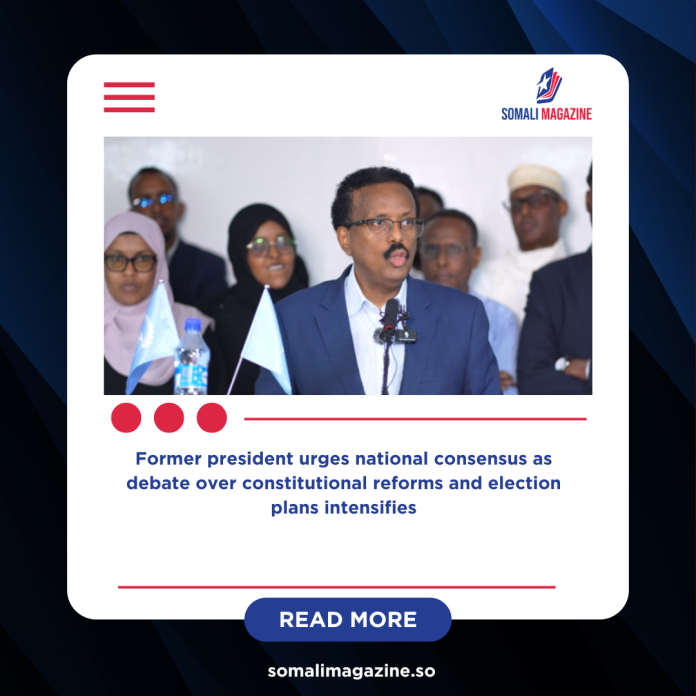
Former Somali President Mohamed Abdullahi Mohamed, widely known as Farmaajo, has warned that Somalia could face serious political instability if recent constitutional changes and election plans move forward without broad national agreement.
Speaking during an iftar meeting with federal lawmakers elected from Puntland on Wednesday, Farmaajo urged President Hassan Sheikh Mohamud to reconsider what he described as unilateral decisions regarding constitutional reforms and the country’s electoral process. He said such moves, if not carefully handled, could deepen divisions and create uncertainty at a critical time in Somalia’s political transition.
Farmaajo emphasized that leadership is temporary and that the authority of a president ends when their constitutional term expires. According to him, leaders must always remain mindful of the limits of their power and the need to respect constitutional timelines. He warned that ignoring these realities could create tension and weaken trust in the country’s political institutions.
The former president cautioned that pushing ahead with controversial constitutional amendments or changes to the election roadmap without national consensus could put Somalia at risk of political turmoil. He noted that decisions affecting the country’s governance structure should involve wide consultation among political leaders, regional administrations, and other key stakeholders.
Farmaajo used strong language to describe how quickly political power can change. He said that leaders sometimes feel powerful while they hold office, but that power does not last forever. For this reason, he advised the current leadership to avoid decisions that could later lead to regret or deepen political conflict.
His comments come after Somalia’s bicameral parliament approved revised constitutional provisions following intense debate among lawmakers. The changes are part of a long-running effort to complete Somalia’s constitutional framework, which has remained provisional since it was first adopted in 2012.
Government officials have defended the amendments, arguing that the constitutional review process has taken far too long and that it was necessary to move forward in order to strengthen Somalia’s governance system. They say finalizing the constitution will help clarify the roles of federal institutions and support the country’s long-term stability.
President Hassan Sheikh Mohamud welcomed parliament’s approval of the changes during a press conference, saying that Somalia needed to resolve the constitutional review process after years of delay. He suggested that completing the reforms would help move the country forward politically.
However, the amendments have faced strong criticism from opposition groups and some regional leaders. The Somali Future Council, an opposition coalition that includes leaders from Puntland and Jubbaland, has voiced concerns about the way the constitutional changes were handled. Critics argue that the amendments were rushed through parliament without sufficient consultation across the country.
Opposition leaders say major decisions about the constitution should involve broader discussions with federal member states and political stakeholders to ensure national consensus. They fear that pushing through reforms without agreement could upset the balance of Somalia’s federal system and lead to deeper political disagreements.
Some political observers have also raised concerns about how the constitutional changes might affect the country’s election timeline. There are questions about whether certain provisions could influence the timing of upcoming elections or potentially extend the current administration’s mandate. Legal experts remain divided on how the new amendments might be interpreted.
Farmaajo stressed that Somalia is already facing serious challenges, including security threats, economic pressure, and humanitarian needs. In his view, the country cannot afford further political divisions at a time when cooperation among leaders is urgently needed.
He called on Somalia’s political leadership to prioritize unity and dialogue in order to safeguard the country’s stability. According to Farmaajo, building consensus and working together will be essential if Somalia is to successfully navigate its political transition and address the many challenges facing the nation.