
Facebook

Twitter (X)

Instagram

Somali Magazine - People's Magazine
Pakistan shares a 900-kilometre border with Iran, making stability in the neighboring country crucial for Islamabad. At the same time, Pakistan has strong political, economic, and military ties with Saudi Arabia and other Gulf states. Millions of Pakistani workers live in the Gulf region, and their remittances play a vital role in Pakistan’s economy. These relationships place Pakistan in a difficult position as the conflict escalates.
The pressure increased further after Pakistan signed a Strategic Mutual Defence Agreement with Saudi Arabia in September 2025. The deal states that an attack on one country would be considered an attack on both. While analysts say the agreement does not automatically force Pakistan into war, it still creates expectations that Islamabad will support Saudi Arabia if the kingdom faces serious threats.
As Iranian missiles and drones continue targeting Gulf states, many observers are asking how Pakistan would respond if Saudi Arabia formally requested military help. So far, Islamabad has focused on diplomacy, trying to prevent the situation from worsening.
Pakistan’s Deputy Prime Minister and Foreign Minister Ishaq Dar has been actively communicating with leaders in both Iran and Saudi Arabia. After the killing of Khamenei, Pakistan quickly condemned the US-Israeli strikes, calling them unjustified. However, Islamabad also criticized Iran for launching attacks on Gulf countries, describing them as violations of sovereignty.
Dar said he personally reminded Iran’s Foreign Minister Abbas Araghchi about Pakistan’s defense agreement with Saudi Arabia. At the same time, Iranian officials reportedly asked Pakistan to ensure that Saudi territory would not be used to launch attacks against Iran. Pakistani diplomats say they helped pass this message between both sides in an effort to reduce tensions.
Despite these efforts, the conflict continues to grow. Saudi Arabia recently confirmed that its air defenses intercepted several Iranian missiles targeting the Prince Sultan Air Base. Soon after, Pakistan’s army chief Field Marshal Asim Munir visited Riyadh to discuss the situation with Saudi defense officials. Their talks focused on how both countries could respond to the security threats under their defense partnership.
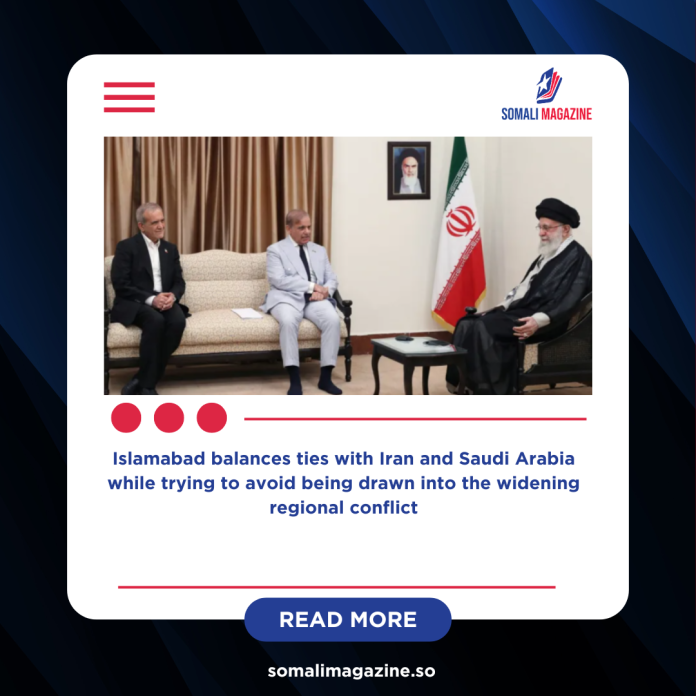
Analysts say Pakistan is walking a diplomatic tightrope. On one side is Saudi Arabia, a long-time ally that hosts thousands of Pakistani troops and millions of workers. On the other side is Iran, a neighboring country with which Pakistan shares trade ties, security concerns, and a sensitive border region.
Pakistan also faces domestic challenges linked to the conflict. Protests erupted across the country after Khamenei’s assassination, especially among the country’s Shia population. Demonstrations turned violent in some areas, forcing authorities to impose curfews and deploy the army to restore order.
Security experts warn that regional tensions could worsen sectarian divisions inside Pakistan. Iran has historically had influence among some Shia groups in the country, and militant networks linked to regional conflicts could become active again if the crisis deepens. Pakistan’s border province of Balochistan, which already faces separatist unrest, could also become more unstable if tensions with Iran rise.
Because of these risks, many analysts believe Pakistan is unlikely to take direct military action against Iran. Instead, Islamabad may provide limited defensive support to Saudi Arabia, such as assistance with air defense systems. This type of support could help protect Saudi infrastructure while allowing Pakistan to avoid direct involvement in offensive operations.
Others believe Pakistan’s most valuable role is diplomacy. The country has working relationships with both Tehran and Riyadh, giving it a unique position to encourage dialogue. Some experts argue that Pakistan should focus on mediation efforts rather than military involvement.
At the same time, Pakistan cannot ignore the economic risks of a wider regional war. Millions of Pakistanis work in Gulf countries, and any disruption to those economies could reduce remittances and hurt Pakistan’s already fragile financial situation. Rising energy prices would also increase pressure on the country’s economy, which relies heavily on Gulf oil.
For now, Pakistan continues to balance its ties with both Iran and Saudi Arabia while pushing for calm. But analysts warn that if the war expands further and Gulf countries formally enter the conflict, Islamabad may eventually be forced to make a difficult choice.