Facebook

Twitter (X)

Instagram

Somali Magazine - People's Magazine
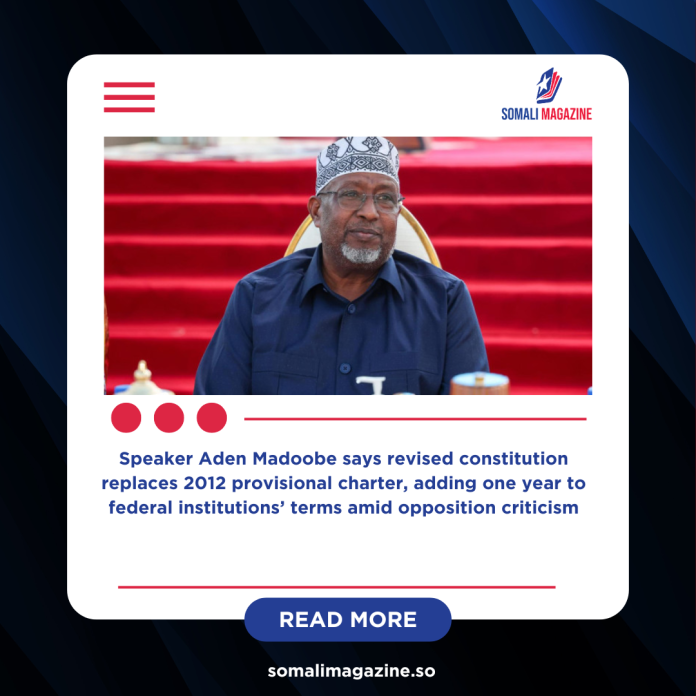
Somalia’s Speaker of the House of the People, Aden Mohamed Nur Madoobe, announced on Thursday that the terms of federal government institutions have been extended from four years to five years under the country’s newly revised constitution. The decision effectively adds one more year to the mandates of current institutions, including parliament and other constitutional bodies.
Madoobe made the announcement during an iftar gathering in Mogadishu, where he explained that Somalia’s political institutions will now operate under the provisions of the new constitution rather than the 2012 provisional one. The earlier charter had limited the mandates of federal institutions to four years, but the updated constitution now sets the term at five years.
According to Madoobe, the change means parliament and other constitutional bodies will follow the timeframe outlined in the newly adopted constitution. He said lawmakers and institutions must now operate based on the official constitution that was recently approved by parliament, marking a shift away from the provisional framework that had guided Somalia’s political system for more than a decade.
The revised constitutional provisions were approved on Wednesday during a joint session of both houses of the federal parliament. The amendments include the new five-year mandate for federal institutions, replacing the earlier four-year limit that had been in place under the provisional constitution since 2012.
During his remarks, Madoobe also urged lawmakers who had been absent from recent parliamentary sessions to return and participate in the remaining legislative work. Some members had boycotted sessions due to disagreements over the constitutional amendments and the broader political direction of the country.
The speaker said parliament still has significant responsibilities ahead, including passing important laws related to state-building and governance. He expressed hope that lawmakers would come together to complete unfinished legislative tasks in the coming sessions.
Madoobe also announced that parliamentary leave would be extended so members could observe religious obligations during the holy month of Ramadan. At the same time, he declared that members of parliament who had previously been suspended would now be allowed to return and resume their duties.
He said the suspensions had effectively been lifted and that the affected lawmakers should come back to parliament like other members and take part in the legislative process.
However, the announcement quickly triggered criticism from opposition figures who argue that the constitutional amendments are being used as a political tool to extend the government’s time in power.
Among the critics was Abdirahman Abdishakur Warsame, who said the opposition had long suspected that extending the term of office was the real objective behind the constitutional changes.
Warsame questioned the timing of the decision, arguing that Somalia is currently facing serious humanitarian challenges, including severe drought affecting many parts of the country. He suggested that national priorities should focus on addressing those crises rather than making political changes that could increase tensions.
The constitutional amendments were approved in a highly divisive vote in parliament. Many opposition lawmakers chose to boycott the session, including those associated with the Somali Future Council and political leaders from the regional states of Puntland and Jubbaland.
Government officials, however, defended the move, saying the amendments are necessary to complete Somalia’s long-delayed constitutional process and clarify the structure of the federal system. According to them, updating the constitution is an important step toward strengthening the country’s political institutions and governance.
Critics remain concerned that the process lacked broad national agreement and could alter the political balance ahead of future elections. They argue that major constitutional decisions should involve wider consultation with federal member states and political stakeholders.
The extension of institutional mandates adds another layer of uncertainty to Somalia’s already complex political environment. The country continues to face disagreements over election models, the distribution of power between the federal government and regional states, and the interpretation of constitutional authority.
As these debates continue, the latest constitutional changes are likely to remain a key issue in Somalia’s political discussions in the months ahead.