
Facebook

Twitter (X)

Instagram

Somali Magazine - People's Magazine
Fuel prices in Somalia’s capital, Mogadishu, have suddenly risen by nearly 77%, adding new financial pressure on families and businesses already struggling with the high cost of living. The sharp increase happened overnight, surprising many residents and raising concerns about how people will manage daily expenses in the coming weeks.
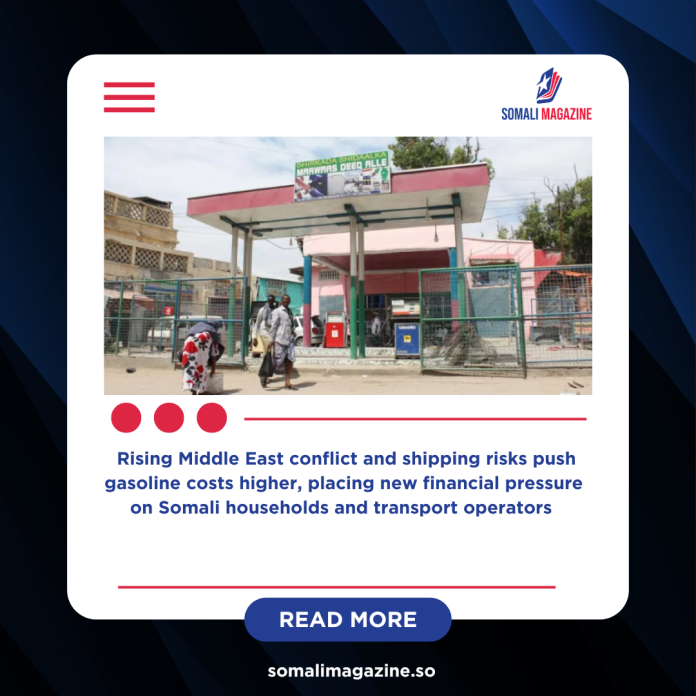
Traders and drivers in Mogadishu reported that the price of a liter of gasoline jumped from around 65 cents to about $1.15 late Friday. The sudden spike has quickly affected daily life across the city. Public transport operators, small business owners, and ordinary consumers are all feeling the impact as transportation and operating costs rise.
For many drivers, the increase came as a shock. Mohamed Ahmed, a taxi driver in Mogadishu, said he went to bed when fuel was still 65 cents per liter, only to wake up and find the price had climbed to more than one dollar. Like many drivers who rely on daily earnings, he worries about how he will continue supporting his family if fuel prices remain this high.
Public transportation operators, including taxi and Bajaj drivers, say they may have no choice but to raise their fares to cover the rising cost of fuel. If that happens, the effect will likely spread throughout the city’s economy. Higher transport costs often lead to increased prices for goods and services because businesses must pay more to move products and operate their activities.
Experts say the price jump is connected to rising tensions in the Middle East, where recent military actions involving the United States and Israel targeting Iran have unsettled global energy markets. These developments have created uncertainty about the stability of oil supply routes and energy infrastructure in the region.
One of the main concerns is the safety of oil shipments traveling through major maritime routes such as the Red Sea and the Gulf of Aden. Tankers passing through these waters are now facing greater security risks, which has pushed insurance costs higher. When shipping companies pay more for insurance and security, those extra costs are often passed down the supply chain, eventually affecting the price consumers pay for fuel.
There are also fears that oil refining facilities and export terminals in the region could face disruptions if tensions continue to escalate. Even the possibility of damage to these facilities can drive up global oil prices, as markets react to the risk of supply shortages.
Global crude oil prices have already seen a significant increase. On Friday, the U.S. benchmark crude price closed at $90.90 per barrel, marking a 36% rise compared to the previous week. Meanwhile, Brent crude, which serves as the international benchmark for oil prices, climbed 27% to settle at $92.69 per barrel during the same period.
Because Somalia relies almost entirely on imported fuel, changes in global oil markets quickly affect local prices. Economists warn that if the instability in the Middle East continues, the country could face even higher fuel costs in the near future.
The consequences may extend beyond transportation. Fuel prices influence many parts of everyday life in Somalia, including electricity generation and food imports. If fuel continues to rise, electricity tariffs could increase, and the price of imported goods, including essential food items, may also go up.
The regional shipping situation is also adding to uncertainty. Reports indicate that ships carrying roughly 20 million barrels of oil each day have experienced delays in the Persian Gulf. Passage through the Strait of Hormuz, one of the world’s most important oil transit routes and partly bordered by Iran, has become increasingly risky due to the ongoing tensions.
For residents of Mogadishu, the sudden price hike has already begun reshaping daily routines. With transport costs rising and the possibility of broader price increases looming, many households are now bracing for further economic strain if the global situation does not stabilize soon.