Facebook

Twitter (X)

Instagram

Somali Magazine - People's Magazine
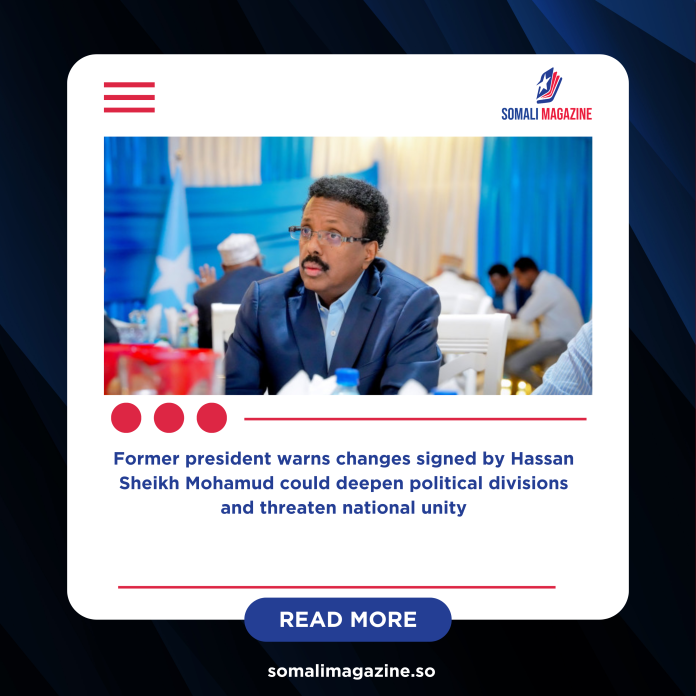
Former Somali President Mohamed Abdullahi Farmaajo has strongly criticized the decision by President Hassan Sheikh Mohamud to sign Somalia’s revised federal constitution into law, warning that the move could threaten national unity and increase political tensions in the country.
In a statement released on Sunday, Farmaajo said the constitutional changes risk weakening the country’s political stability and could undermine the spirit of cooperation needed during an already sensitive period. He emphasized that the constitution represents a national agreement that belongs to all Somalis, and therefore any major changes should be made through wide consultation and agreement among all stakeholders.
Farmaajo argued that the process used to amend the constitution did not involve enough dialogue with key political groups and leaders. According to him, constitutional reforms should be guided by broad political consensus and careful discussions rather than what he described as a one-sided approach. He warned that changes made without strong national agreement could create deeper divisions within Somalia’s political landscape.
His comments came shortly after President Mohamud officially signed the revised Federal Constitution during a ceremony held in Mogadishu. The signing marked the completion of a constitutional review process that replaces the provisional charter adopted in 2012 at the end of Somalia’s transitional government period.
Under the newly approved provisions, the mandates of key federal institutions, including parliament and the presidency, have been extended to five years. Previously, the constitution limited these terms to four years. Supporters of the reform argue that the changes will help provide more stability for government institutions and allow leaders enough time to implement policies and reforms.
However, Farmaajo said that several federal member states, members of parliament from both chambers, and other political stakeholders have already raised serious concerns about the way the amendments were approved. He noted that many political leaders and former officials have warned the changes could lead to disputes over legality and political legitimacy.
According to Farmaajo, the constitutional review process has moved away from the original roadmap that was agreed upon when the provisional constitution was first adopted. That roadmap emphasized dialogue, inclusion, and a gradual approach to constitutional reform. He called on the current leadership to reconsider the process and reopen discussions with different political actors to avoid creating new political conflicts.
Farmaajo also stressed that Somalia’s political leaders should focus on maintaining unity and strengthening cooperation, especially at a time when the country continues to face several major challenges. These include ongoing security threats, economic difficulties, and humanitarian issues affecting many communities.
The debate surrounding the constitutional amendments has become one of the most controversial political issues in Somalia in recent weeks. Government officials have defended the changes, saying the constitutional review was necessary to clarify how the federal system works and to strengthen the country’s state institutions.
On the other hand, opposition leaders and critics argue that the process moved too quickly and did not involve enough consultation with federal member states and other political groups. They say such an important national document should only be revised after thorough discussions and strong agreement across the political spectrum.
Somalia adopted its provisional constitution in 2012 after years of conflict and political transition. At the time, leaders agreed that the document would later undergo a comprehensive review to address gaps and strengthen governance structures. However, progress on that review has been slow over the years due to disagreements among political actors.
Farmaajo concluded his statement by urging Somali leaders to return to dialogue and national consultation. He warned that political disagreements over the constitution could deepen divisions if not handled carefully. According to him, preserving national unity and political stability should remain the country’s top priority as Somalia continues its journey toward stronger governance and long-term peace.