Facebook

Twitter (X)

Instagram

Somali Magazine - People's Magazine
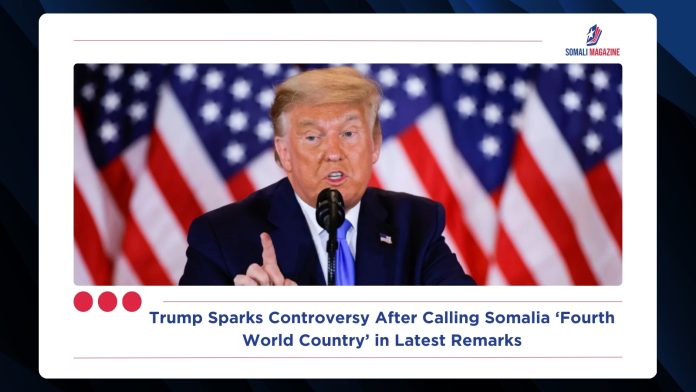
Trump sparks controversy after calling Somalia ‘fourth world country’, a remark that has ignited widespread criticism and renewed debate about international perceptions of the Horn of Africa nation. The comments, attributed to Donald Trump during a recent public appearance, quickly circulated across global media, prompting reactions from Somali officials, diaspora communities, and political analysts.
The statement has been widely criticized as dismissive and inaccurate, with many pointing out that the term “fourth world country” lacks a formal definition in modern economic or geopolitical discourse. Somalia, while facing long-standing challenges related to security and development, is internationally recognized as a federal republic working to rebuild its institutions after decades of conflict.
Trump sparks controversy after calling Somalia ‘fourth world country’ at a time when the country has been making gradual progress in governance, economic reform, and security operations against extremist groups. Somali officials have not issued a unified formal response, but several political figures and commentators have rejected the characterization, emphasizing the resilience and potential of the nation.
The remarks have also raised concerns about the broader implications for US-Somalia relations, particularly in areas such as security cooperation and humanitarian assistance. The United States has been a key partner in supporting Somalia’s efforts to combat Al-Shabab and stabilize key regions, making diplomatic tone and mutual respect an important part of ongoing engagement.
Analysts note that political rhetoric involving developing nations often shapes public perception in ways that can have lasting consequences. In this case, the comments have sparked a wider conversation about how African countries are portrayed in global discourse and the importance of balanced, fact-based narratives.
Members of the Somali diaspora, particularly in the United States, have been among the most vocal critics. Community leaders and advocacy groups have used social media and public forums to challenge the statement, highlighting Somalia’s cultural richness, economic potential, and the achievements of its global diaspora.
At the same time, some observers have called for measured responses, noting that political statements, especially during high-profile events, can sometimes be intended to provoke or draw attention. They argue that sustained diplomatic engagement and factual representation are more effective in shaping international understanding.
Trump sparks controversy after calling Somalia ‘fourth world country’ also underscores the evolving nature of global political communication, where remarks can quickly gain traction and influence narratives far beyond their original context. For Somalia, the moment presents both a challenge and an opportunity to reaffirm its progress and push back against outdated stereotypes.
As discussions continue, the focus is likely to remain on how leaders, both within Somalia and internationally, respond to such statements and work to maintain constructive dialogue in an increasingly interconnected world.