
Facebook

Twitter (X)

Instagram

Somali Magazine - People's Magazine
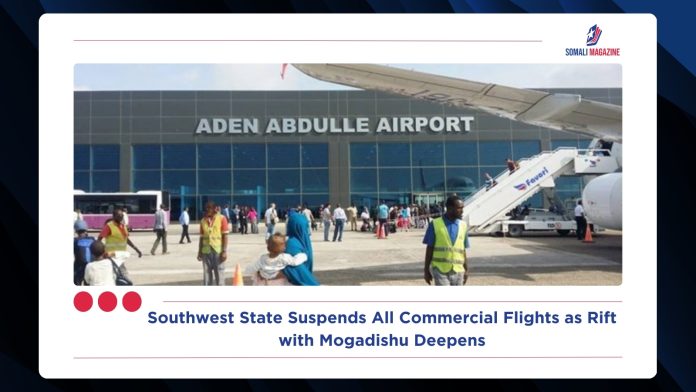
Southwest State suspends all commercial flights, marking a dramatic escalation in the ongoing standoff with Mogadishu and intensifying concerns over Somalia’s fragile political landscape. The decision, announced by regional authorities, effectively halts civilian air travel to and from key المدن in Southwest State Somalia, signaling a sharp deterioration in relations with the federal government.
Officials in the region cited security and administrative disputes as the primary reasons behind the suspension, pointing to unresolved issues with federal authorities overseeing aviation operations. The move is widely seen as part of a broader pattern of resistance by regional administrations amid growing Mogadishu tensions, particularly over control of infrastructure and governance mechanisms.
The federal government has previously emphasized its constitutional mandate over national airspace, arguing that centralized coordination is necessary for safety and efficiency. However, leaders in Southwest State Somalia contend that recent directives from Mogadishu have been imposed without adequate consultation, further fueling the federal government conflict that has simmered for months.
The impact of the decision is already being felt on the ground. Passengers, traders, and humanitarian operators face disruptions, with the suspension of flights threatening to isolate parts of the region. Somalia air travel disruption has long been a sensitive issue, given the country’s reliance on aviation to connect distant المناطق where road infrastructure remains limited or insecure.
Analysts warn that the latest development could deepen the Somalia political crisis, particularly if similar actions are adopted by other federal member states. Aviation, often viewed as a neutral and essential service, has now become entangled in political disputes, raising concerns about the broader implications for national unity and economic stability.
International observers, including representatives from multilateral organizations, have consistently urged dialogue between Mogadishu and regional leaders. Past interventions have highlighted the need for clearer frameworks governing resource sharing and administrative authority, but progress has been uneven. The current situation underscores the urgency of resolving these disputes through institutional channels rather than unilateral actions.
While there has been no immediate indication of when flights might resume, both sides are under increasing pressure to de-escalate. For ordinary citizens, the suspension represents more than a political statement—it disrupts livelihoods, access to services, and connections with the wider country.
As Southwest State suspends all commercial flights, the episode serves as a stark reminder of the challenges facing Somalia’s federal system. The path forward will likely depend on renewed negotiations, with the stakes extending far beyond aviation into the broader question of how power is shared in a still-recovering nation.