
Facebook

Twitter (X)

Instagram

Somali Magazine - People's Magazine
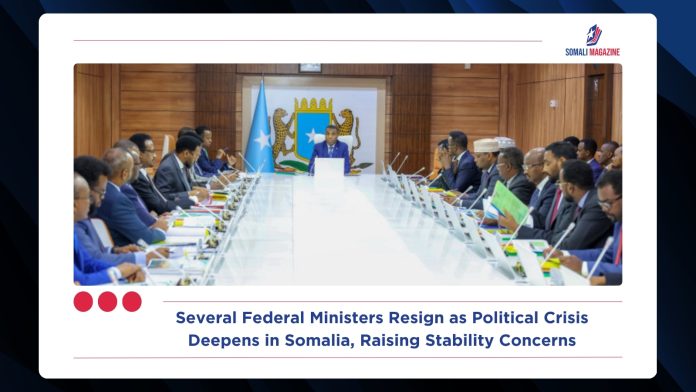
Several federal ministers resign as political crisis deepens in Somalia, marking a significant escalation in tensions within the country’s leadership and raising fresh concerns about political stability. The resignations, confirmed through official statements and government sources, come at a time when Somalia is already grappling with complex governance challenges and strained relations between federal institutions.
The departures are widely seen as a reflection of growing government instability Somalia, with disagreements over policy direction, leadership decisions, and institutional authority reportedly contributing to the crisis. While details surrounding individual resignations remain limited, analysts suggest the move signals deeper fractures within the federal administration.
At the center of the unfolding situation are persistent federal leadership tensions, which have increasingly defined Somalia’s political landscape in recent months. Disputes between key figures in government have slowed decision-making processes and complicated efforts to address pressing national issues, including security, economic recovery, and humanitarian needs.
The Somalia political crisis has been further exacerbated by disagreements between the federal government and regional states, as well as internal divisions within the cabinet. Observers note that such cabinet resignations Somalia are not uncommon in fragile political systems, but the timing and scale of the current developments underscore the seriousness of the situation.
Government officials have sought to reassure the public, emphasizing continuity in governance and the commitment to filling vacant positions promptly. However, critics argue that repeated leadership changes risk undermining public confidence and weakening institutional effectiveness. The lack of stability at the top can also have ripple effects across various sectors, from service delivery to international partnerships.
Experts point out that Somalia governance challenges are deeply rooted in the country’s evolving federal system, where balancing power among different actors remains a delicate process. While progress has been made in rebuilding state institutions over the past decade, political cohesion continues to be tested by competing interests and limited resources.
International partners, including the United Nations and African Union, have consistently encouraged Somali leaders to prioritize dialogue and consensus-building. In previous instances, external mediation has played a role in easing tensions, though long-term solutions ultimately depend on domestic political will.
As several federal ministers resign as political crisis deepens in Somalia, the focus now shifts to how the leadership responds to the unfolding developments. The ability to manage the transition effectively and restore confidence will be critical in determining the country’s near-term stability.
For many Somalis, the hope remains that this moment of uncertainty can be turned into an opportunity for reform and renewed commitment to inclusive governance. Whether that hope materializes will depend on the actions taken in the days ahead.