Facebook

Twitter (X)

Instagram

Somali Magazine - People's Magazine
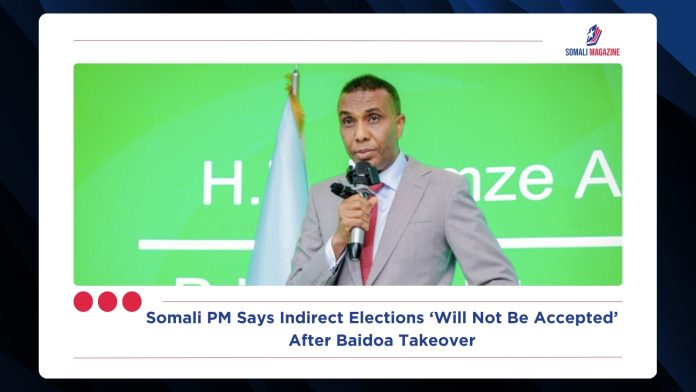
Somali PM indirect elections have come under renewed scrutiny after Hamza Abdi Barre declared that the system “will not be accepted,” following the federal government’s takeover of Baidoa. The statement marks one of the strongest positions yet from the federal leadership on the future of Somalia’s electoral model.
Speaking after federal forces secured control of Baidoa, the Prime Minister emphasized that Somalia must move beyond indirect elections toward a more democratic, one-person one-vote system. The remarks come amid heightened political tensions between the federal government and regional administrations, particularly in Southwest State, where Baidoa serves as a key political and administrative hub.
Indirect elections have been a defining feature of Somalia’s political system for years, with clan elders and delegates selecting members of parliament, who in turn elect the president. While the model was initially adopted due to security and logistical challenges, critics argue that it limits public participation and undermines democratic accountability. The federal government Somalia has increasingly pushed for reforms aimed at expanding voter inclusion.
The Baidoa takeover is widely seen as a turning point in this ongoing debate. Federal authorities have framed the move as part of broader efforts to assert constitutional order and ensure alignment with national electoral goals. Government officials insist that transitioning to direct elections is essential for long-term stability and legitimacy.
However, the development has also raised concerns among some regional leaders and political stakeholders. Critics warn that the use of federal forces in politically sensitive regions could escalate tensions and complicate dialogue on electoral reforms. Analysts note that Somalia’s political landscape remains delicate, requiring careful negotiation between federal and state actors.
Despite these concerns, the Prime Minister’s remarks signal a clear policy direction. By rejecting the continuation of indirect elections, the government is positioning itself firmly behind electoral transformation. The push for one-person one-vote Somalia elections has been a long-standing ambition, though its implementation faces significant hurdles, including security challenges, voter registration systems, and institutional readiness.
International partners have also shown interest in Somalia’s electoral transition, often linking support to progress in governance and democratic reforms. The success of these efforts will depend on cooperation across political divides and the ability to build trust in new electoral mechanisms.
As the situation in Baidoa stabilizes, attention is likely to shift toward how the federal government translates its position into actionable reforms. The coming months will be critical in determining whether Somalia can move closer to a more inclusive and transparent electoral process, or whether political divisions will continue to shape its democratic trajectory.