
Facebook

Twitter (X)

Instagram

Somali Magazine - People's Magazine
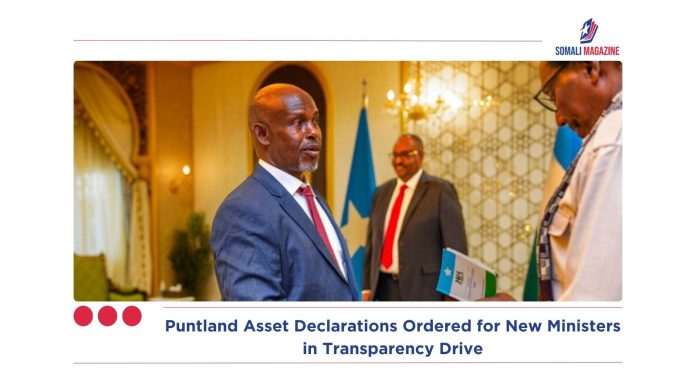
The directive on Puntland asset declarations marks a significant step in the region’s evolving governance framework, as newly appointed ministers have been ordered to publicly disclose their wealth. Announced by Puntland authorities shortly after the formation of the new cabinet, the move is being positioned as part of a broader effort to enhance transparency and rebuild public trust in government institutions.
Officials within the Puntland administration have framed the requirement as a necessary measure to strengthen public accountability Puntland and deter corruption at the highest levels of leadership. By mandating minister asset disclosure, the government aims to create a clear baseline against which any unexplained wealth accumulation can be assessed during officials’ time in office. Such measures are increasingly viewed as essential in regions seeking to modernise governance systems and align with international standards.
The policy arrives at a time when questions around integrity and oversight continue to shape political discourse across Somalia. While federal and regional governments have made periodic commitments to Puntland government transparency, implementation has often lagged due to institutional challenges. Observers note that the latest directive could signal a shift toward more enforceable accountability mechanisms, particularly if backed by independent verification and consistent follow-through.
In practical terms, ministers are expected to submit detailed declarations outlining assets, income sources, and financial interests. These disclosures may include property holdings, business investments, and other significant economic assets. Though the exact mechanisms for public access and verification remain under development, officials suggest that the process will be structured to ensure both accuracy and oversight.
Anti-corruption advocates have cautiously welcomed the announcement, describing it as a positive, if overdue, development. Transparency International and similar watchdog organisations have long emphasised the importance of asset declaration systems in combating illicit enrichment and reinforcing anti-corruption Somalia initiatives. However, they also stress that the effectiveness of such policies depends heavily on enforcement, institutional independence, and political will.
For Puntland, a semi-autonomous region that has often been seen as relatively stable compared to other parts of Somalia, the directive could enhance its reputation as a leader in governance reform. It also reflects a broader recognition that economic development and investor confidence are closely tied to transparent public institutions. Clear rules around financial disclosure can help create a more predictable environment for both domestic and international stakeholders.
At the same time, analysts caution that asset declarations alone cannot address systemic governance challenges. They must be accompanied by stronger legal frameworks, empowered oversight bodies, and a culture of accountability that extends beyond political cycles. Without these elements, disclosure risks becoming a symbolic gesture rather than a transformative tool.
Still, the introduction of Puntland asset declarations represents a notable moment in the region’s political trajectory. As newly appointed ministers comply with the directive, attention will turn to how effectively the system is implemented and whether it can deliver on its promise of greater transparency. For citizens and observers alike, the initiative offers a tangible measure of Puntland’s commitment to accountable governance in a rapidly changing political landscape.