
Facebook

Twitter (X)

Instagram

Somali Magazine - People's Magazine
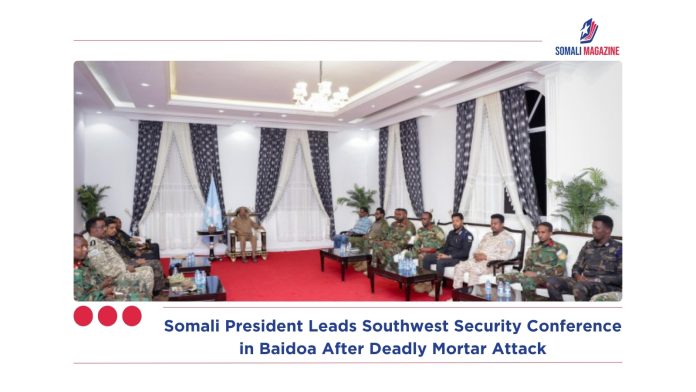
In the tense aftermath of a deadly assault, the Somali President Southwest security conference convened in Baidoa has emerged as a pivotal moment in the country’s ongoing fight to stabilise its regions. The high-level meeting, chaired by Hassan Sheikh Mohamud, comes just days after a mortar attack rattled the southwestern town, underscoring the fragile security landscape that continues to challenge Somalia’s federal and regional authorities.
The Baidoa mortar attack, which targeted key areas of the administrative capital of Southwest State, raised fresh concerns about the operational capabilities of militant groups, particularly Al-Shabaab. Although security forces have intensified surveillance and countermeasures, the incident served as a stark reminder of the persistent threats facing both civilians and government institutions.
Against this backdrop, the Somali President Southwest security conference brought together senior federal officials, regional leaders, and security commanders to reassess strategies and reinforce coordination. Discussions reportedly focused on strengthening intelligence-sharing frameworks, enhancing local security deployments, and accelerating joint military operations aimed at dismantling extremist networks embedded within the region.
Government sources indicate that President Mohamud emphasised the importance of unity between federal and state institutions, noting that fragmented efforts could undermine progress made in recent offensives against insurgent groups. His administration has consistently prioritised a multi-pronged approach—combining military pressure with community engagement—to weaken Al-Shabaab’s influence, particularly in rural strongholds.
Baidoa, a strategic hub in southern Somalia, has long been at the centre of efforts to stabilise the country’s Southwest State. The town hosts key administrative offices and serves as a logistical base for security operations, making it a frequent target for attacks intended to disrupt governance and erode public confidence. Analysts suggest that such incidents are often timed to coincide with major political or security gatherings, amplifying their psychological and symbolic impact.
The Somalia security situation remains complex, shaped by decades of conflict, political fragmentation, and evolving insurgent tactics. While recent military gains have pushed Al-Shabaab out of several territories, the group continues to demonstrate resilience through asymmetric warfare, including mortar strikes and targeted assassinations.
Observers note that the Southwest state security meeting in Baidoa signals a renewed urgency within the federal government to consolidate gains and prevent backsliding. The presence of top leadership at the conference also sends a strong message of commitment to both domestic and international partners supporting Somalia’s stabilisation efforts.
As deliberations continue, the success of the Somali President Southwest security conference will likely depend on how effectively its resolutions translate into tangible improvements on the ground. For residents of Baidoa and beyond, the hope is that coordinated action will not only deter future attacks but also lay the groundwork for lasting peace in a region that has endured years of uncertainty.