
Facebook

Twitter (X)

Instagram

Somali Magazine - People's Magazine
The recent twin explosions in Damascus wounded eighteen people on Tuesday during a highly publicized, landmark visit by French President Emmanuel Macron to the rebuilding nation. According to a statement issued by the Syrian Interior Ministry, the coordinated detonations occurred near the heavily guarded Four Seasons Hotel and the Ministry of Tourism headquarters in the heart of the capital. State media reports indicated that security personnel had discovered the improvised devices—one concealed inside a parked vehicle and another hidden within a roadside garbage container—and the blasts occurred while active technical preparations were underway to safely dismantle them. Medical personnel rushed to the dense central thoroughfare to treat the injured, who included four local law enforcement officers, while investigators cordoned off the damaged vehicles and shattered storefronts.
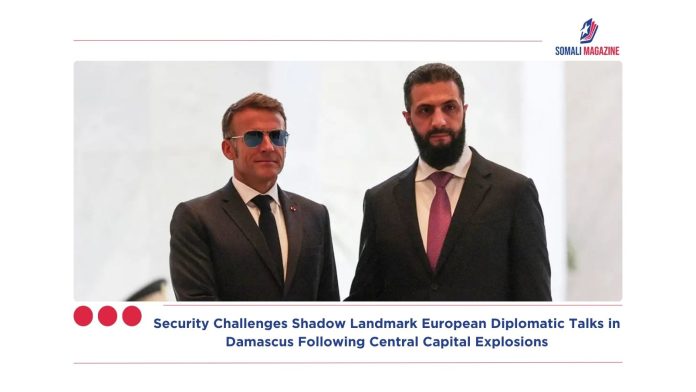
The security disruption unfolded precisely as President Ahmed al-Sharaa welcomed the French delegation at the presidential palace, located several kilometers away from the epicenter of the blast zone. Officials from the Elysee Palace confirmed that the French head of state was completely secure, did not hear the detonations, and proceeded with the scheduled high-level meetings as planned. This diplomatic mission marks the first time a major Western European leader has traveled to Syria since the political transition and the collapse of the previous regime in late 2024. While no insurgent organization immediately claimed direct responsibility for the dual bombings, the incident underscores the persistent structural vulnerabilities facing the transitional government as it attempts to project stability and reengage with international partners.
Despite the immediate threat, the bilateral European diplomatic talks moved forward, resulting in the signing of over a dozen foundational agreements focused on restoring critical public utilities, including municipal electricity and regional water networks. French policy experts noted that the decision to maintain the itinerary was an intentional sign of resilience, intended to reinforce collaborative efforts to rebuild the country’s battered infrastructure. Addressing reporters during a joint press conference following the incident, Macron emphasized that specific extremist factions would not be permitted to derail the diplomatic reintegration of the state into the broader global community.
The political developments in the Syrian capital represent a critical test for the ruling administration, which continues to lobby international bodies to lift long-standing economic sanctions and fund massive post-conflict reconstruction initiatives. Regional analysts observe that transitioning from internal conflict to a verified global security partnership requires rigorous data sharing and modernized counter-terrorism operations. As national security services carry out forensic investigations into the remnants of the explosive devices, the resilience of the newborn diplomatic pipeline remains central to the region’s long-term economic recovery.