
Facebook

Twitter (X)

Instagram

Somali Magazine - People's Magazine
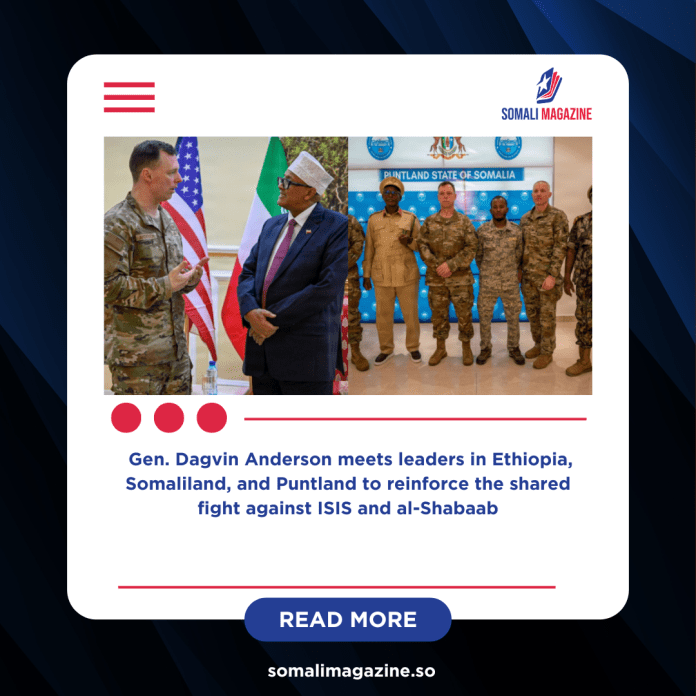
U.S. Africa Command (AFRICOM) Commander Gen. Dagvin Anderson has begun a series of high-level visits to Africa, starting with stops in Ethiopia, Somaliland, and Puntland. The trip reflects Washington’s renewed push to strengthen counterterrorism partnerships across the continent and highlight the United States’ commitment to confronting extremist groups that continue to threaten regional and international security.
In a statement released on Monday, AFRICOM said Gen. Anderson’s visit sends a strong message that the United States supports maintaining “maximum pressure” on ISIS, al-Shabaab, and other violent extremist organizations operating in East Africa. The visit also aligns with the priorities of U.S. President Donald Trump and Secretary of War Pete Hegseth, who have emphasized the importance of safeguarding the U.S. homeland by expanding cooperation with African partners.
Speaking during the trip, Gen. Anderson said he was in the region to strengthen joint efforts against common threats. “I’m not new to this region; I understand what the issues are, and we’re here to help empower our African partners to address these threats in a united way,” he noted.
Throughout his tour, Anderson met with government leaders and security officials to promote a more coordinated strategy focused on burden sharing, deeper cooperation, and aligned security priorities. His message emphasized that terrorism is a regional challenge that no country can confront alone and that partnerships are essential for long-term success.
The first stop was Ethiopia, where Anderson met with Prime Minister Abiy Ahmed and the Chief of Defense, Field Marshal Birhanu Jula Gelelcha. Discussions centered on the growing threat posed by extremist groups such as ISIS and al-Shabaab, particularly as they expand recruitment and operations across the Horn of Africa. Both sides agreed on the importance of increasing collaboration to prevent these groups from destabilizing the region.
From Ethiopia, Anderson traveled to Somaliland, where he held talks with President Abdirahman Mohamed Abdullahi, the chief of the Somaliland Armed Forces, Brig. Gen. Niman Yusuf Osman, and Coast Guard Commander Adm. Ahmed Hurre Hariye. He also visited the port city of Berbera to assess security around the area and to review the port’s capacity to support regional stability efforts. Berbera’s location along key maritime routes makes it strategically important for counterterrorism, maritime security, and economic activity.
The final stop on Gen. Anderson’s trip was Puntland. There, he met Vice President Ilyas Osman Lugatoor, Puntland Defense Forces Commander Gen. Adan Abdi Hashi, and other senior officials. Discussions focused on the region’s ongoing campaign against ISIS militants hiding in the Golis Mountains. Anderson commended Puntland’s recent progress but urged leaders to continue intensifying operations to fully degrade terrorist cells operating in the area.
Across all meetings, Anderson repeated that the United States remains committed to supporting African partner forces that have shown measurable progress in tackling extremist threats. He emphasized that counterterrorism success requires unity, shared responsibility, and continuous collaboration.
“As we face growing security threats, including the rise of terrorist activities in East Africa, the Sahel, and West Africa’s coastal regions, collective efforts are more important than ever,” he said. “Together we can build a more prosperous and secure future for the United States, for Africa, and most importantly, for our children.”
AFRICOM concluded that Africa remains an important region where instability can influence not only the continent but also Europe and global security. The command stressed that the United States cannot afford to shift its attention away from Africa, given the evolving threats and the need for strong, dependable partnerships.