
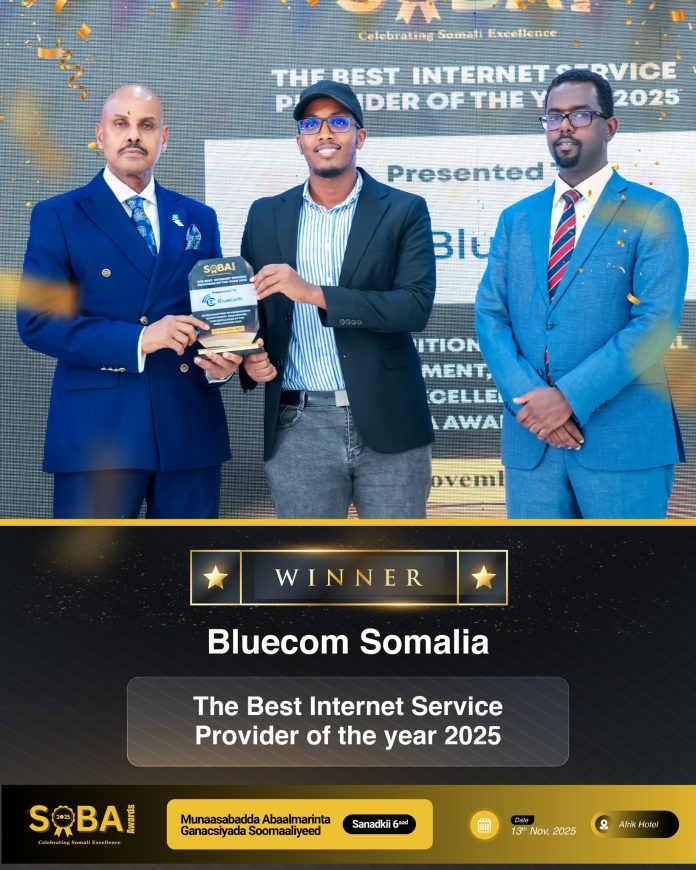
Bluecom Somalia’s coronation as “Best Internet Service Provider of the Year 2025” at the SOBA Awards is more than a ceremonial victory — it is a signal that Somalia’s digital future is finally being shaped by companies that marry ambition with tangible service delivery. In a market long stymied by infrastructure gaps, regulatory uncertainty, and affordability challenges, Bluecom’s rise reflects focused investment, operational discipline, and an appetite for community-centered innovation. This recognition should be celebrated, but it must also be measured against the larger task of turning connectivity into inclusive development.
What stands out about Bluecom is not merely headline metrics — faster speeds or improved uptime — but the company’s willingness to deploy resources where private profit and public good overlap: schools, small businesses, and underserved neighborhoods. Subsidized packages, community Wi‑Fi hotspots, and local training initiatives show an understanding that internet access is not an end in itself but a platform for education, entrepreneurship, and social participation. If Bluecom sustains and scales these efforts, the firm can help transform connectivity from a luxury into a foundation for economic resilience across Somalia.
Still, accolades should not be a blank check. Awards can mask persistent problems: pricing that remains out of reach for many households, the patchy quality of rural coverage, and the environmental and logistical challenges of running infrastructure in fragile regions. Bluecom’s pledge to explore renewable-energy base stations and prioritize rural rollouts is promising, but success will require transparent targets, independent monitoring, and cooperation with regulators and communities to ensure equitable outcomes.
The SOBA honor places Bluecom at the center of both expectation and opportunity. The company now has an obligation to translate recognition into measurable social returns: lower prices, wider coverage, local hiring, and durable service SLAs. For policymakers and donors, this moment should be an incentive to support public–private partnerships that reduce deployment costs and expand digital literacy programs — because private sector success alone cannot bridge Somalia’s digital divide.
In short, Bluecom’s award is an encouraging milestone. Celebrations are warranted, but so too is scrutiny and ambition. If the company and its partners use this momentum to deepen inclusion and demonstrate accountable growth, Somalia’s next decade could be defined not by connectivity gaps but by the real, everyday benefits of being online.