
Facebook

Twitter (X)

Instagram

Somali Magazine - People's Magazine
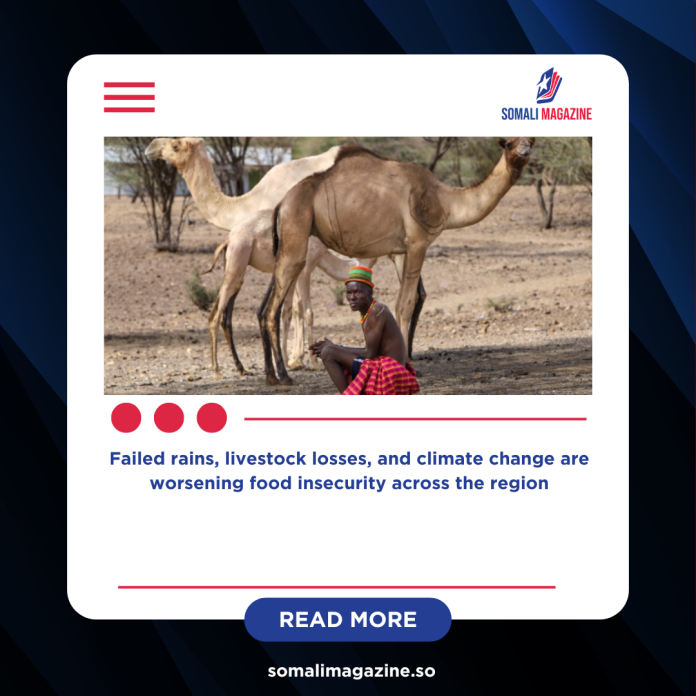
Drought conditions are pushing more than two million people in parts of Kenya toward hunger, with pastoralist communities in the northeast suffering the most. According to the United Nations and other humanitarian agencies, the crisis is worsening as rains continue to fail and water sources dry up. Recent images of severely weakened livestock near Kenya’s border with Somalia have alarmed many people and highlighted how deeply climate change is affecting the region.
For communities that depend on livestock for survival, the loss of animals is often the first and most painful sign of drought. In recent years, rainy seasons have become shorter and less reliable, leaving grazing land dry and forcing families to travel long distances in search of pasture and water. When animals die, families lose not only food but also income, transport, and their main source of security.
What is happening now mirrors the devastating drought experienced between 2020 and 2023, when millions of livestock died across Kenya, Somalia, and Ethiopia. During that period, Somalia came close to famine, but large-scale international aid helped prevent the worst outcomes. This time, however, humanitarian agencies warn that early support is not keeping pace with rising needs.
Parts of the Horn of Africa have now experienced four consecutive failed wet seasons. The rains that usually fall between October and December were among the weakest ever recorded, according to the World Health Organization. In eastern Kenya, rainfall levels during that season were the lowest seen since the early 1980s. Because the rains were short and uneven, they did little to restore water points or revive pasture.
Kenya’s National Drought Management Authority reports that at least 10 counties are currently facing drought conditions. Mandera County, which borders Somalia, has reached an “alarm” level. This classification signals severe water shortages, widespread livestock deaths, and increasing cases of child malnutrition. Families in these areas are struggling to find enough food, and health services are under pressure as children show signs of wasting.
The impact of the drought is not limited to Kenya. Neighboring countries including Somalia, Tanzania, and Uganda are also dealing with similar weather patterns and shrinking water supplies. In southern Somalia, aid organizations report severe food shortages that are forcing families to abandon their homes in search of help. Somalia, already highly vulnerable to drought, has seen more than three million people displaced internally over the years due to recurring climate shocks and conflict.
Conditions in displacement camps are especially difficult. In cities like Baidoa, many displaced families survive on one meal a day or less. Aid groups say children in these camps are visibly malnourished, with limited access to clean water, healthcare, and proper nutrition. While humanitarian assistance is reaching some people, it remains far below what is needed to prevent a deeper crisis.
Experts largely agree that climate change is driving these worsening conditions. Warmer temperatures in the Indian Ocean have fueled stronger and more destructive storms, while dry periods on land are lasting longer and becoming more severe. This combination has made weather patterns increasingly unpredictable.
For millions of Africans who rely on rain-fed farming and livestock, these changes are devastating. Crops fail, pasture disappears, and families are left with few options to cope. Africa is particularly exposed to climate shocks because many countries lack the resources to prepare for and respond to natural disasters. Despite contributing only a small share of global greenhouse gas emissions, the continent faces some of the harshest impacts of climate change.
Without timely support, experts warn that hunger and displacement will continue to rise, deepening an already fragile humanitarian situation across the region.