
Facebook

Twitter (X)

Instagram

Somali Magazine - People's Magazine
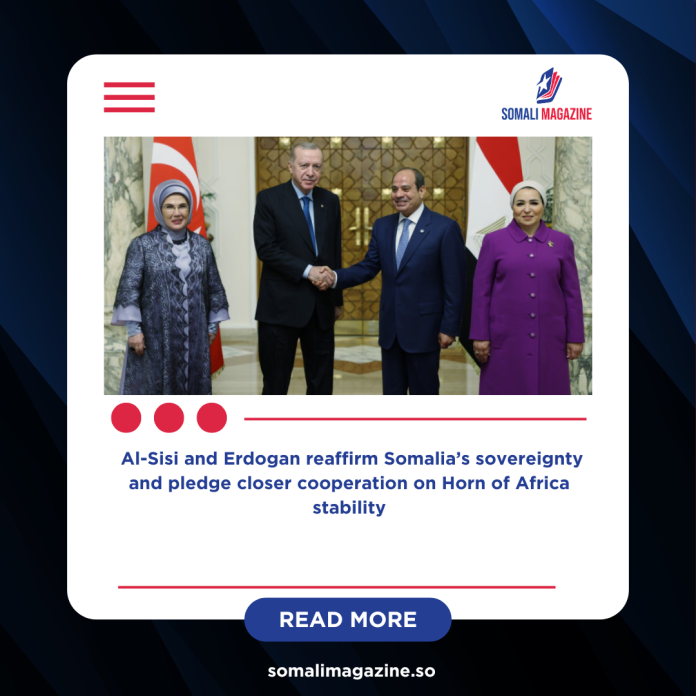
Egyptian President Abdel Fattah al-Sisi and Turkish President Recep Tayyip Erdogan have jointly reaffirmed their strong support for Somalia’s sovereignty and territorial integrity, firmly rejecting Israel’s recent decision to recognize Somaliland. The two leaders made their position clear during a high-level meeting held in Cairo on Wednesday, where they discussed bilateral ties as well as key regional and international issues affecting Africa and the Middle East.
The meeting took place ahead of the Egypt–Türkiye High-Level Strategic Cooperation Council and focused on strengthening relations between Ankara and Cairo while addressing shared concerns in the Horn of Africa. Somalia featured prominently in the discussions, alongside the ongoing conflicts in Sudan and Gaza and broader regional security matters.
President Erdogan stated that Turkey does not recognize any decisions related to Somaliland, stressing that Ankara’s stance is based on the protection of Somalia’s unity. He emphasized that Israel’s move undermines the sovereignty and territorial integrity of the Somali state and violates widely accepted international principles. According to remarks released after the meeting, Erdogan made it clear that Turkey considers Somalia’s borders and political unity non-negotiable.
Egypt echoed Turkey’s position. Egyptian presidential spokesman Mohamed El-Shennawy said the talks included a private session between the two leaders, during which they exchanged views on regional security, political stability, and cooperation. Both presidents agreed that developments in Somalia and the wider Horn of Africa directly affect regional stability and therefore require close coordination and ongoing consultation.
Turkey and Egypt were among the first countries to openly reject Israel’s recognition of Somaliland, which was announced in late December. The decision sparked strong criticism across Africa and the Arab world, with many governments warning that it could destabilize the region and encourage separatist movements. Somalia’s federal government has since intensified diplomatic efforts to rally international support and block any recognition attempts.
Somaliland declared independence from Somalia in 1991 following the collapse of the central government. However, despite maintaining its own administration and relative stability, it has not been recognized by the international community. Somalia continues to view Somaliland as an integral part of its territory and insists that any political future for the region must be resolved through dialogue within the framework of Somalia’s sovereignty.
Beyond Somalia, al-Sisi and Erdogan also discussed the conflicts in Sudan and Gaza. Both leaders stressed the importance of de-escalation, respect for national sovereignty, and non-interference in the internal affairs of states. They agreed that lasting solutions to regional conflicts can only be achieved through political dialogue, regional cooperation, and adherence to international law.
The talks also highlighted the improving relationship between Egypt and Turkey after years of strained ties. Once regional rivals, the two countries have recently taken significant steps toward reconciliation, driven by shared economic and security interests. Following the meeting, Egypt and Turkey signed several agreements and memorandums of understanding covering areas such as defense, trade, investment, health, and agriculture.
These agreements signal a growing partnership between Ankara and Cairo and a shared desire to play a more coordinated role in regional affairs. Analysts see the joint stance on Somalia as part of a broader effort by both countries to promote stability in Africa and counter moves they believe could undermine existing states.
For Somalia, the public backing from two influential regional powers is a significant diplomatic boost. As Mogadishu continues to push back against recognition efforts, support from allies like Egypt and Turkey reinforces its position on the international stage and strengthens calls for respect for Somalia’s sovereignty and territorial integrity.