
Facebook

Twitter (X)

Instagram

Somali Magazine - People's Magazine
Turkey’s President Recep Tayyip Erdogan has strongly rejected Israel’s decision to recognize Somaliland as an independent country, warning that the move could increase instability in the already fragile Horn of Africa region.
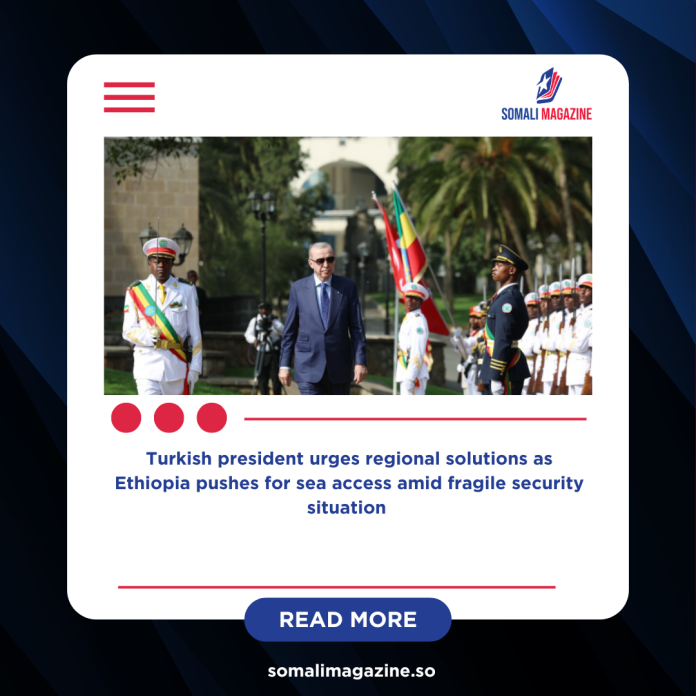
Speaking during an official visit to Ethiopia on Thursday, Erdogan said the Horn of Africa should not become a playground for outside powers. He stressed that countries in the region should resolve their own issues without foreign interference. His remarks come after Israel, in December, became the first country to formally recognize Somaliland, a territory that declared independence from Somalia more than 30 years ago.
Somalia’s federal government in Mogadishu reacted angrily to Israel’s recognition, maintaining that Somaliland remains part of its territory. Although Somaliland has operated with its own government, currency, and security forces since 1991, it has not received widespread international recognition.
Erdogan’s comments also carry weight because Turkey has played an increasingly active diplomatic and economic role in the Horn of Africa, particularly in Somalia and Ethiopia. In the past, Turkey has invested heavily in Somalia’s infrastructure, security, and humanitarian support. Two years ago, tensions rose when Ethiopia announced plans to lease part of Somaliland’s coastline to build a port. Somalia strongly opposed the move, arguing it violated its sovereignty. At the time, Erdogan stepped in to help mediate between the two sides, easing fears that the dispute could spiral into a broader conflict.
In response to Erdogan’s latest remarks, Somaliland’s foreign ministry urged Turkey to avoid statements that could escalate tensions. Officials in Hargeisa argued that external comments risk complicating an already sensitive regional situation.
During a joint press conference in Addis Ababa with Ethiopian Prime Minister Abiy Ahmed, Erdogan reiterated his position. He emphasized that stability in the Horn of Africa is crucial and warned against actions that could turn the region into a battleground for foreign interests.
At the same event, Prime Minister Abiy used the opportunity to press Ethiopia’s long-standing demand for sea access. Ethiopia has been landlocked since Eritrea gained independence in 1993, losing direct access to the Red Sea. With a population of over 130 million people, Abiy argued that it is unfair for Ethiopia to remain without a coastline.
In recent years, Ethiopia has explored various options to secure port access. After the earlier Somaliland port agreement collapsed in 2024, Abiy signaled interest in gaining access to Eritrea’s southern port of Assab, located near the Ethiopian border. His comments in the past have raised concerns, especially when he suggested that Ethiopia could consider force if diplomatic efforts fail.
During his meeting with Erdogan, Abiy said he had asked Turkey to support Ethiopia diplomatically in its push for sea access. He expressed appreciation for Turkey’s willingness to engage in discussions and potentially assist in finding a peaceful solution.
These developments come at a time of growing concern over security in northern Ethiopia, particularly in the Tigray region, which borders Eritrea. The Tigray war between 2020 and 2022 left deep scars, with Eritrean forces fighting alongside Ethiopia’s federal army against Tigrayan fighters. Although a peace agreement was reached, tensions remain high.
Recent reports from local media suggest increased military activity near Tigray, raising fears of renewed conflict. Economic strain in the region has also added to public anxiety, with reports of cash shortages in banks and delayed salary payments for civil servants.
Against this tense backdrop, Erdogan’s warning reflects broader concerns that new diplomatic moves—such as recognizing Somaliland—could further complicate an already delicate balance in the Horn of Africa.