
Facebook

Twitter (X)

Instagram

Somali Magazine - People's Magazine
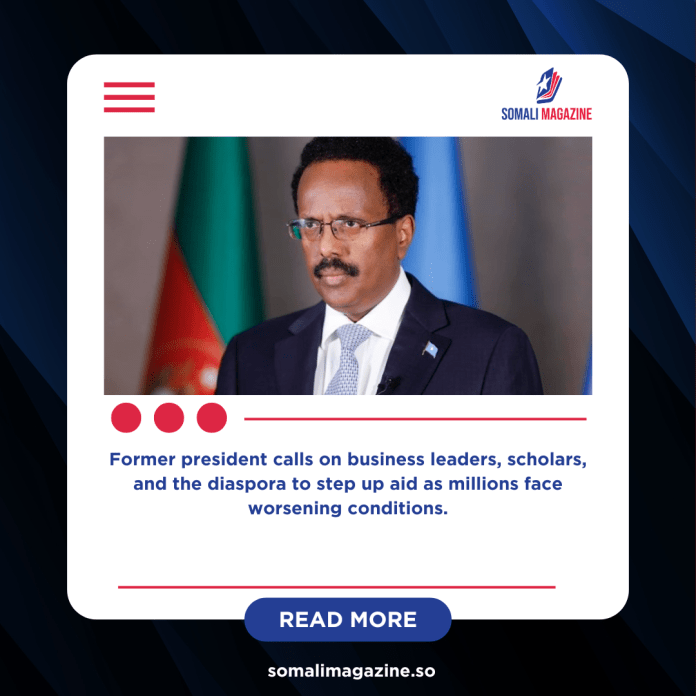
Former Somali President Mohamed Abdullahi Farmaajo has issued a renewed call for Somali business leaders, religious scholars, and community members to increase their support for families affected by the ongoing drought, as humanitarian needs continue to grow across the country. In a statement released on Wednesday, Farmaajo said thousands of vulnerable households have gone two years without receiving adequate aid, leaving them in increasingly desperate conditions. He emphasized that many communities, especially those in rural and hard-to-reach areas, are struggling to cope after consecutive failed rainy seasons, which have destroyed crops, killed livestock, and weakened traditional coping systems that families rely on during difficult times.
Farmaajo noted that international assistance—which Somalia has depended on heavily during previous droughts—has fallen sharply and is no longer enough to cover the urgent needs that continue to rise every day. Because of this gap, he urged Somalis inside and outside the country to take “collective responsibility” by mobilizing resources to support affected families. He specifically appealed to scholars, business owners, and the Somali diaspora, saying these groups have always played a critical role during national emergencies and are uniquely positioned to provide timely help.
The former president also encouraged stronger cooperation between leaders of the Federal Government and the Federal Member States, urging them to work more closely in coordinating drought response efforts. He said unity and collaboration among Somali institutions is essential to ensure that aid reaches those in the most severely impacted regions. Farmaajo expressed hope that government leaders would prioritize the crisis and coordinate with local authorities, community elders, and humanitarian organizations to speed up the distribution of food, water, and other essential supplies.
While expressing appreciation for ongoing humanitarian efforts, Farmaajo appealed to the international community to scale up its support, stressing that millions of people are now at risk of hunger, disease, and displacement. He said Somalia’s crisis is worsening each month, and without timely action, more families will be forced to leave their homes in search of food and water. According to UN humanitarian agencies, Somalia is currently experiencing one of its most severe droughts in decades, following four consecutive failed rainy seasons. This prolonged dry period has driven millions of Somalis into food insecurity and created a growing risk of famine in several regions.
The Federal Government of Somalia formally declared a drought emergency on 10 November, calling for urgent international assistance as conditions deteriorate rapidly across northern, central, and southern parts of the country. Government officials have warned that the number of people in need could rise sharply in the coming months if rain patterns do not improve and if humanitarian support is not increased. Communities that depend on farming and pastoralism have been hit hardest, with many losing livestock—an essential source of income, food, and stability.
In his appeal, Farmaajo reminded Somalis that the country has overcome multiple crises in the past through unity and collective action. He urged people with the means to contribute—whether through donations, community fundraising, or direct support to families on the ground—to do so quickly. He said supporting drought-affected communities is not only a humanitarian duty but also a crucial step in protecting Somalia’s social and economic stability. Strengthening local solidarity, he added, will help prevent further displacement and ensure vulnerable families retain the dignity and resilience needed to rebuild when conditions eventually improve.
Farmaajo concluded by expressing hope that all stakeholders—Somali citizens, the government, humanitarian partners, and the international community—will work together to prevent further suffering. He emphasized that timely action can save lives and reduce the long-term impact of the drought on Somalia’s future.
The future steps will depend on how quickly the stabilization force can be organized, whether all parties cooperate with its deployment, and how negotiations progress in the months ahead. For now, the resolution stands as one of the strongest international signals calling for a permanent ceasefire, rebuilding efforts, and a political process that could eventually lead to lasting peace in the region.