
Facebook

Twitter (X)

Instagram

Somali Magazine - People's Magazine
Early after arriving in the United States in 2009, Abdi Daisane would often tell his relatives back in Africa about one major difference in his new life. In the Kenyan refugee camp where his family had once lived after fleeing Somalia, he always had to carry immigration papers. There was constant fear of being stopped, questioned, or even detained. In America, he felt free from that pressure. He didn’t have to prove who he was at every turn. For the first time in years, he felt safe.
But over the past two months, that sense of safety has faded.
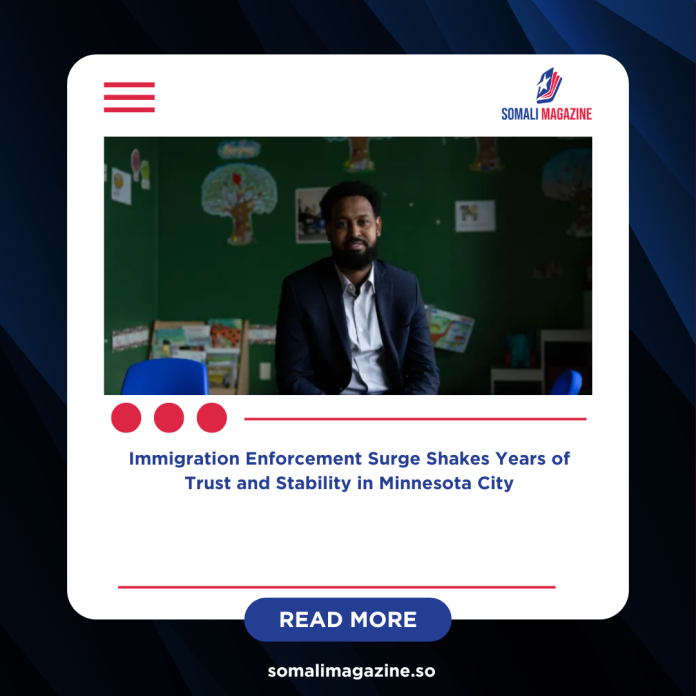
Daisane, who now lives in St. Cloud and is running for an open seat in the Minnesota State House, says recent immigration enforcement operations have changed daily life for many Somali residents. With Immigration and Customs Enforcement (ICE) agents increasing their presence in parts of Minnesota, he found himself doing something he never imagined after living in the U.S. for more than 17 years — carrying his passport everywhere.
“For someone who’s been here that long, having to carry documents again is hard to accept,” he said.
St. Cloud, a city in central Minnesota, has been home to Somali refugees for nearly three decades. Over time, the community has grown into a visible and active part of the city’s social and economic life. Somali-owned businesses, community organizations, and local leaders have helped shape the area. But the recent surge in ICE operations has shaken that progress.
There have been reports of Somali residents being detained and federal agents operating in neighborhoods and near businesses. An incident at a local shopping center filled with Somali-owned stores drew widespread attention. Many residents say the atmosphere has been tense ever since.
Community leaders describe the past few months as emotionally and financially draining. Amin Ali, director of the Somali American Rights Coalition, says families have been living with fear and uncertainty. Some parents were afraid to leave home for work. Children worried about whether their loved ones would return safely. Small businesses reported losing customers, and some workers lost jobs.
“It has been a very heavy time emotionally and financially for our community,” Ali said.
Ahmed Abdi, manager of St. Cloud Somali Community Radio, has been tracking reports of immigration enforcement closely. Although there was an announcement that ICE operations in Minnesota would be scaled back, community observers have continued to report seeing agents in the area. According to Abdi, even if tactics change, the fear created during this period will not disappear quickly.
He is also concerned about the long-term impact of public rhetoric linking Somali Americans to high-profile fraud cases. Following the pandemic-era Feeding Our Future scandal in Minnesota, some political figures, including former President Donald Trump and Representative Tom Emmer, made broad statements that many in the Somali community felt unfairly painted them as criminals. Community leaders argue that these comments failed to separate individuals accused of wrongdoing from the larger, law-abiding Somali population.
Abdi worries such narratives could hurt job opportunities and deepen mistrust. “In this country, everything is about trust,” he said. “When false narratives spread, it affects how people see us.”
Despite the challenges, many Somali residents still see St. Cloud as home. Daisane moved there in 2013 after enrolling at St. Cloud State University. He saw opportunity — a place to build a business, raise a family, and help his mother connect with others in the community. Over time, he opened a daycare center that serves local families.
Recently, however, his business became the target of harassment after a viral online video accused some Somali-run childcare centers elsewhere of fraud. Though his daycare had no connection to the claims, it received threatening calls. People even came to take photos outside the building. Staff members underwent safety training as a precaution.
Local foundations stepped in with emergency grants to support Somali and East African businesses facing losses. Community leaders are now calling for expanded economic recovery programs and more access to mental health support, especially for young people who have experienced fear and hostility.
Ali believes the community’s response shows resilience. Neighbors supported one another. Organizations worked together. Advocacy efforts increased. He says the goal is not only to recover but to grow stronger.
Daisane agrees that healing will take time. He hopes the tension and fear of recent months do not become the new normal. “It’s going to take time,” he said, “but we will eventually recover.”