
Facebook

Twitter (X)

Instagram

Somali Magazine - People's Magazine
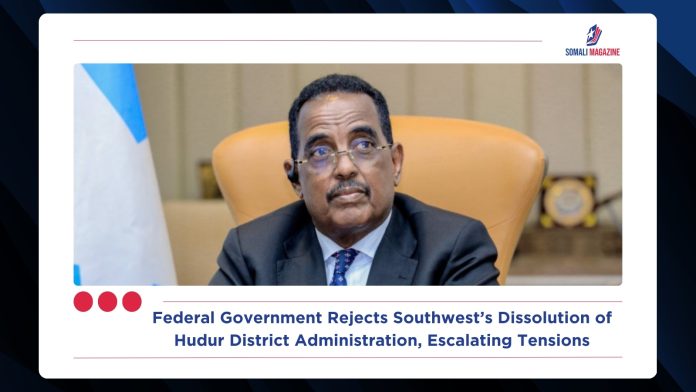
Federal government rejects Southwest’s dissolution of Hudur district administration, intensifying an already fragile political situation between Mogadishu and regional authorities. The decision highlights growing disagreements over administrative control and governance structures in parts of Southwest State Somalia.
Officials in the federal government stated that the move to dissolve the Hudur administration was not in line with constitutional procedures, emphasizing that such decisions must involve proper consultation and legal frameworks. Hudur, located in the Bakool region, remains a strategically important district, both politically and in terms of security coordination.
The Hudur district dispute reflects broader Somalia political tensions that have increasingly defined relations between the federal government and member states. While regional administrations maintain a degree of autonomy under Somalia’s federal system, disputes often arise over jurisdiction, authority, and resource management. In this case, federal authorities argue that unilateral actions risk undermining institutional stability.
Leaders in Southwest State Somalia have yet to fully clarify their position following the federal rejection, though similar disputes in the past have often been linked to internal political realignments or efforts to restructure local governance. Analysts suggest that such moves can sometimes be driven by competing interests at the regional level, further complicating the federal state conflict Somalia continues to navigate.
Governance disputes Somalia have been a recurring challenge since the country adopted its federal model. While the system was designed to balance power between central and regional authorities, implementation has often been uneven. Experts point out that the absence of clear mechanisms for dispute resolution has contributed to recurring tensions.
The federal government has called for dialogue to resolve the matter, urging Southwest leaders to engage in consultations aimed at finding a mutually acceptable solution. International partners, including the United Nations and African Union, have consistently encouraged Somali leaders to address such disagreements through peaceful and institutional channels.
For residents of Hudur, the uncertainty surrounding administrative leadership raises concerns about service delivery and local governance. Stability at the district level is critical for maintaining security and ensuring access to basic services, particularly in regions that have faced ongoing challenges related to conflict and development.
As Federal government rejects Southwest’s dissolution of Hudur district administration, the situation underscores the delicate balance required to manage Somalia’s federal structure. The outcome of this dispute could set an important precedent for how similar conflicts are handled in the future.
The coming days are likely to determine whether both sides can reach a compromise or whether tensions will escalate further. For Somalia, the priority remains clear: strengthening governance systems while preserving unity in a complex political landscape.