
Facebook

Twitter (X)

Instagram

Somali Magazine - People's Magazine
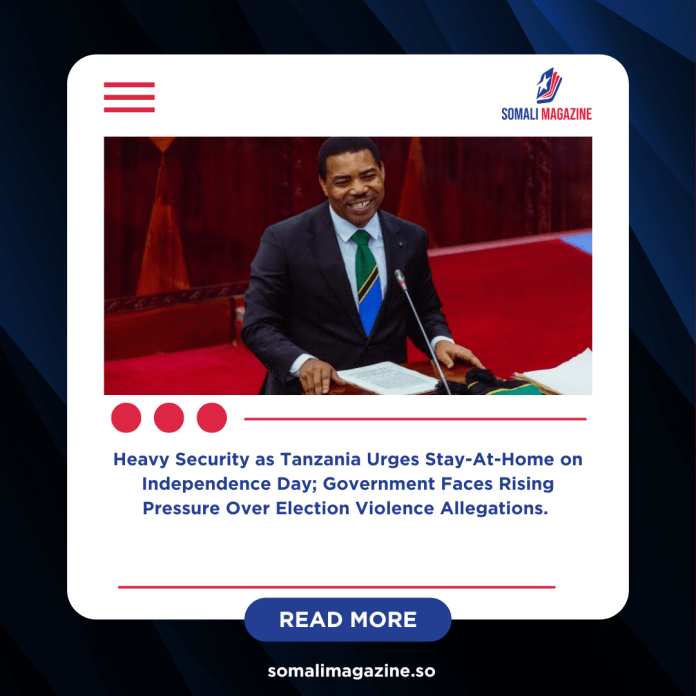
Tanzania’s Prime Minister, Mwigulu Nchemba, has urged citizens to stay at home on Tuesday, a day when activists have called for nationwide protests against the violent crackdown that followed the country’s October elections. The demonstrations were sparked by widespread anger over the exclusion of major opposition candidates from the polls, a decision that critics say severely undermined the credibility of the election process.
According to the United Nations, hundreds of people were likely killed during these protests. The organisation has raised serious concerns about the level of force used by Tanzanian security agencies. The government has admitted that people lost their lives, but it has not released its own casualty figures and has strongly denied allegations that police acted unlawfully or used excessive violence. Officials maintain that protesters were attempting to destabilise the country.
President Samia Suluhu Hassan was declared the winner of the election with nearly 98% of the vote, a result that sparked disbelief and anger among opposition supporters. Many viewed the outcome as the result of a tightly controlled political environment that left little room for contesting voices. After the election, reports of arrests, intimidation, and violent confrontations between security forces and protesters spread across the country, further fuelling public frustration.
Calls for new protests began circulating on social media last month, especially ahead of December 9, a symbolic day marking Tanzania’s independence from Britain. In response, the government announced that there would be no official Independence Day celebrations this year. Instead, Prime Minister Nchemba encouraged people to use the day to rest at home unless they had essential work duties. His message, shared in a video posted on the government’s official X account, did not directly mention the planned demonstrations but made it clear that authorities wanted people off the streets.
Police also warned that any protests on December 9 would be considered illegal, saying they had not received formal notice from organisers as required by law. Officers stressed that they would take action against anyone participating in what they described as unauthorised gatherings. The announcement came as people in cities such as Dar es Salaam and Arusha reported seeing heavy deployments of police and army units along major roads, signalling heightened security measures ahead of the expected demonstrations.
President Hassan has tried to manage the public outcry by appointing a commission to investigate the violence linked to the election period. However, she has repeatedly defended the security forces, insisting that they acted appropriately and did not use unnecessary force. She has argued that many of the protesters were not demonstrating peacefully but were instead attempting to undermine or even overthrow the government.
International reactions have grown sharper in recent weeks. The United States, a long-time development partner of Tanzania, announced that it is reviewing its relationship with the country due to concerns about violence against civilians, restrictions on freedom of speech, threats to religious freedom, and growing barriers to business and investment. Washington’s statement reflects increasing pressure from the global community for Tanzanian authorities to address allegations of rights violations and political repression.
As the situation continues to unfold, many Tanzanians remain anxious about the government’s response to dissent and the broader climate of political freedom in the country. The call for people to stay home on a national holiday—combined with visible police and military presence—has left ordinary citizens unsure of what to expect next. Whether the protests proceed or not, the debate over political rights and the use of force is likely to shape Tanzania’s national conversation for months to come.