
Facebook

Twitter (X)

Instagram

Somali Magazine - People's Magazine
Human Rights Watch (HRW) says it has found evidence that Israel used white phosphorus in residential areas of southern Lebanon earlier this month, raising serious concerns about violations of international humanitarian law.
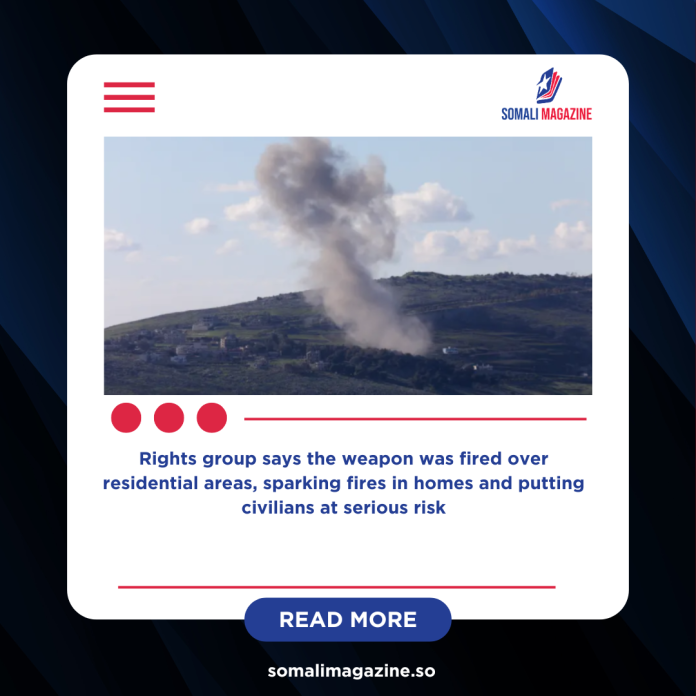
In a report released on Monday, the New York-based rights organization said it verified several images showing white phosphorus munitions being fired over the town of Yohmor in southern Lebanon on March 3. According to the report, the attacks caused fires that damaged at least two homes in the area.
HRW said it carefully examined and confirmed the authenticity of seven photographs related to the incident. The images show artillery-fired white phosphorus exploding in the air above a residential neighborhood. Shortly after the explosions, fires broke out in homes and other civilian structures.
Ramzi Kaiss, a Lebanon researcher with Human Rights Watch, warned that using white phosphorus in populated areas poses a serious risk to civilians. He said the Israeli military’s actions were extremely concerning and could have severe consequences for people living in the affected areas.
“The incendiary effects of white phosphorus can cause death or very serious injuries that may leave victims suffering for the rest of their lives,” Kaiss said.
White phosphorus is a chemical substance that ignites when it comes into contact with oxygen. Once ignited, it burns intensely and can easily start fires. When used in areas where civilians live, it can set homes, farmland, and other civilian properties on fire, causing widespread damage and injury.
Under international humanitarian law, weapons must not be used in ways that are indiscriminate or that fail to protect civilians. HRW said that airburst white phosphorus — which spreads burning material over a wide area — is particularly dangerous when used over populated neighborhoods.
The organization said its investigators verified and geolocated a photograph shared by Lebanese media on the morning of March 3. The image shows at least two white phosphorus artillery shells exploding in the air above Yohmor.
The smoke patterns seen in the photograph matched the distinctive cloud shape created by the M825-series 155mm artillery projectile, a type of munition known to contain white phosphorus.
Human Rights Watch also examined additional photos posted on Facebook by the civil defense team of the Islamic Health Committee in Yohmor. The images show emergency workers putting out fires on rooftops and extinguishing flames in a car within the town.
Based on the location of the fires and the airburst explosions, HRW concluded that the fires were likely caused by small burning pieces of material containing white phosphorus that fell from the exploding shells.
The organization said these fragments, often made of felt soaked with white phosphorus, can spread over a wide area when the munition bursts in the air. Once they land, they continue burning and can easily ignite buildings, vehicles, or vegetation.
Human Rights Watch called on Israel to immediately stop using white phosphorus in residential areas. The group also urged countries that supply weapons to Israel to reconsider their military support.
Kaiss said governments providing weapons — including white phosphorus munitions — should suspend military aid and arms sales if the weapons are being used in ways that put civilians at risk.
The report comes during a period of escalating violence between Israel and Hezbollah along the Lebanon-Israel border. Israeli forces have recently carried out a number of attacks in southern Lebanon and parts of Beirut.
Lebanon’s National News Agency reported that Israel launched several air strikes on Monday in Beirut’s southern suburbs. The strikes targeted areas between the neighborhoods of Ghobeiry and Haret Hreik, as well as the Safir area.
Israel’s military said the strikes were aimed at Hezbollah positions in the Lebanese capital. However, the ongoing attacks have caused significant casualties and destruction.
According to available figures, at least 394 people have been killed and more than 1,000 others injured in Lebanon as a result of Israeli attacks.
The violence has also forced hundreds of thousands of people to flee their homes. More than half a million residents in Lebanon have been registered as displaced following Israeli evacuation orders and continuing air strikes.
Human Rights Watch also noted that this is not the first time white phosphorus has reportedly been used in the region. The organization said Israeli forces had previously used the substance in border villages in southern Lebanon between October 2023 and May 2024.
The rights group warned that the continued use of such weapons puts civilians at serious risk and increases the danger of long-term harm to communities already affected by conflict.
HRW urged Israel’s allies, including the United States, the United Kingdom, and Germany, to suspend military sales to Israel and consider imposing targeted sanctions on officials believed to be responsible for serious violations of international law.
The organization said stronger international action is needed to ensure the protection of civilians and to prevent further harm during the ongoing conflict.