
Facebook

Twitter (X)

Instagram

Somali Magazine - People's Magazine
Hunger is rising fast across Somalia after four consecutive failed rainy seasons and major cuts in humanitarian funding, according to a new report by the Integrated Food Security Phase Classification (IPC). The findings paint a worrying picture of a country once again facing deep food insecurity just as many families were trying to recover from previous droughts.
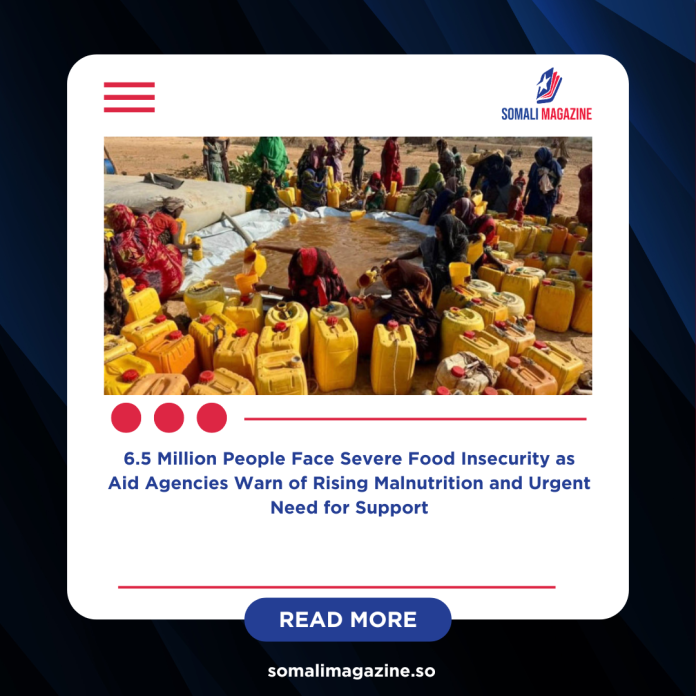
The report shows that 4.8 million people were already facing Crisis-level or worse food insecurity in January. That number is expected to climb to 6.5 million between February and March. This is nearly double the number recorded at the same time last year, highlighting how quickly conditions are deteriorating.
Children are among the hardest hit. The IPC warns that more than 1.8 million children under the age of five are likely to suffer from acute malnutrition in 2026. In several areas, malnutrition rates have already crossed emergency levels, meaning children are at serious risk of illness and death if they do not receive urgent treatment.
The prolonged drought has devastated pastoral and farming communities across Puntland, Somaliland, and central and southern Somalia. Livestock, which many families depend on for both food and income, have died in large numbers due to lack of water and pasture. Crops have failed, and food prices have continued to rise, making it harder for families to afford basic meals.
As incomes shrink, families are being forced to sell off the few animals they have left and reduce the number of meals they eat each day. In areas affected by conflict, insecurity has made it even harder for aid agencies to reach those in need.
For many families, the drought has wiped out their only source of livelihood. Hawo Mohamed Jama, who lives in central Somalia, says her family’s animals were once healthy and strong. Now they are weak and dying because there is no grass or water. She fears they could lose everything if the situation does not improve.
Aid organizations working on the ground say the suffering is becoming more visible. CARE Somalia’s Country Director, Ummy Dubow, said teams are seeing animal herds nearly wiped out and children showing clear signs of severe malnutrition. Some families are reportedly walking up to 30 kilometers in search of water, a sign of how desperate the situation has become.
Women and girls are facing even greater risks. Dubow explained that in many households, women and girls eat last, which means they are often the first to suffer when food is scarce. The drought has also increased protection concerns, including a higher risk of violence and exploitation. In some cases, families resort to early or forced marriage for girls as a coping strategy during hard times.
This crisis follows the severe drought between 2021 and 2023, which was one of the worst in decades. Many families have not yet rebuilt their livestock herds or recovered financially from that disaster. Communities have now given this drought a name: “Abaartii Oomaan” or “Biyo La’aan Ba’an,” meaning “the severe waterless drought.” Naming a drought reflects how deeply people feel its impact and how historic they believe it to be.
At the same time, humanitarian funding has dropped sharply. Aid agencies say they have had to scale back food assistance, nutrition programs, water services, and emergency healthcare, even as the number of people in need continues to rise. The United Nations’ humanitarian response plan for Somalia is currently at one of its lowest funding levels in years.
Humanitarian groups warn that without urgent funding and expanded assistance during the Jilaal dry season from January to March, food insecurity and malnutrition will worsen. CARE is calling for flexible donor funding, stronger support for local and women-led organizations, and diplomatic efforts to ensure aid workers can safely access affected communities.
Together with local partners such as WASDA Somalia, Save Somali Women and Children, and Daryeel Bulsho Guud, CARE is providing emergency water, hygiene supplies, healthcare, cash assistance, and protection services in ten regions, including Sool, Sanaag, Togdheer, Mudug, Galgadud, Banadir, Bari, Lower Jubba, Nugal, and Gedo.
Even if the next rainy season brings average rainfall, an estimated 5.5 million people are still expected to face crisis-level hunger later in 2026. Officials warn that recovery from such an extreme drought will take time, and without sustained support, millions of Somalis will remain at risk.