
Facebook

Twitter (X)

Instagram

Somali Magazine - People's Magazine
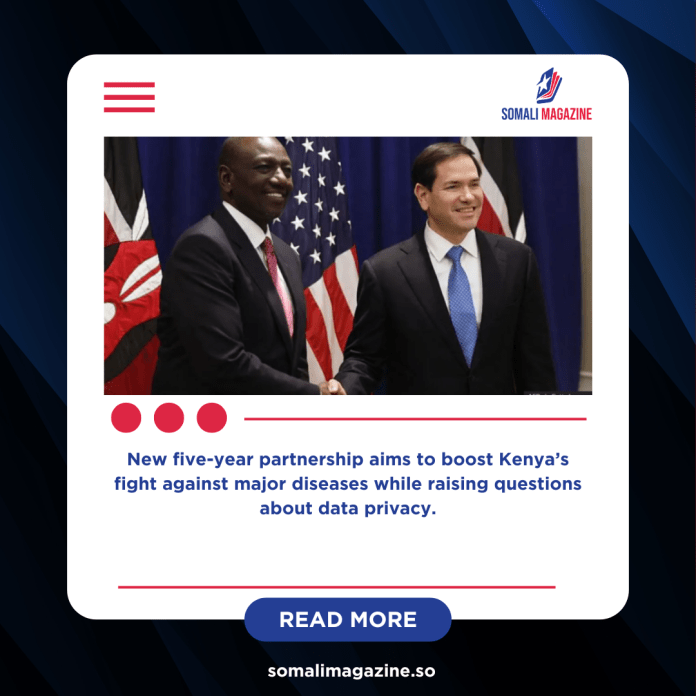
Kenya has signed a major five-year health partnership with the United States, marking the first agreement of its kind since the Trump administration reshaped the way America handles foreign aid. The deal, worth $2.5 billion, focuses on tackling infectious diseases in Kenya and could become a model for similar agreements with other African nations that align with the foreign policy direction of the current U.S. government.
Under the agreement, the United States will contribute $1.7 billion while the Kenyan government will provide $850 million and gradually take on more financial responsibility. The funding will go toward preventing and treating HIV/Aids, malaria, tuberculosis, improving maternal care, supporting polio eradication, and strengthening Kenya’s readiness for infectious disease outbreaks. President William Ruto said the money will also be used to upgrade hospital equipment and expand the health workforce. He assured Kenyans that both governments will spend the funds “efficiently, effectively, and accountably.”
US Secretary of State Marco Rubio, who signed the deal alongside President Ruto, called it a “landmark agreement,” praising Kenya as a reliable partner. He also highlighted Kenya’s leadership in the UN-backed peacekeeping mission in Haiti, saying that if more countries contributed the way Kenya has, global security efforts would greatly improve.
One major shift in this agreement is the U.S. government’s plan to send aid directly to partner governments instead of routing it through NGOs and charities. Rubio argued that this change ensures governments like Kenya have more control and influence over how health funds are used. According to him, the U.S. does not want to continue spending billions through what he described as the “NGO industrial complex” when close partners can manage the funds directly.
However, the deal has raised concerns over data privacy among Kenyan citizens, activists, and lawyers. Some fear the agreement could give the U.S. access to sensitive health information stored in Kenya’s systems, including personal medical records. Critics argue that the government should release the full agreement so the public can understand exactly what data will be shared and what protections exist. Lawyer Willis Otieno questioned whether categories such as genomic data, disease trends, mental health information, insurance records, hospital files, or biometric data are included—and why such details are not clearly written in the publicly released summaries. Whistle-blower Nelson Amenya echoed these concerns, urging the government to make the full document available for public review.
Kenya’s Health Minister Aden Duale has strongly dismissed the privacy fears. He clarified that only “de-identified, aggregated data” will be shared, meaning the information will not include names or details that can be traced back to individual patients. He emphasized that Kenya’s health information remains protected under national laws and described the country’s health data as a “national strategic asset.” For now, U.S. officials have not commented on the data-sharing issue, but Kenyan authorities insist that patient privacy will not be compromised.
The agreement comes after major changes in U.S. foreign aid, including a freeze on international assistance early in Trump’s presidency, the dismantling of USAID, and massive funding cuts to developing countries. These decisions caused shortages of essential medicines in many places. The Trump administration later launched the “America First Global Health Strategy,” making aid dependent on negotiations intended to reduce what it described as waste and ensure U.S. priorities were met. The Kenya deal is one of the first major examples of this new approach, and American officials say several more African countries may sign similar agreements before the end of the year.
Overall, the partnership between Kenya and the U.S. is expected to significantly strengthen Kenya’s health system, but questions around data privacy remain at the center of public debate. The government continues to assure citizens that transparency and security will guide the implementation of the agreement.