
Facebook

Twitter (X)

Instagram

Somali Magazine - People's Magazine
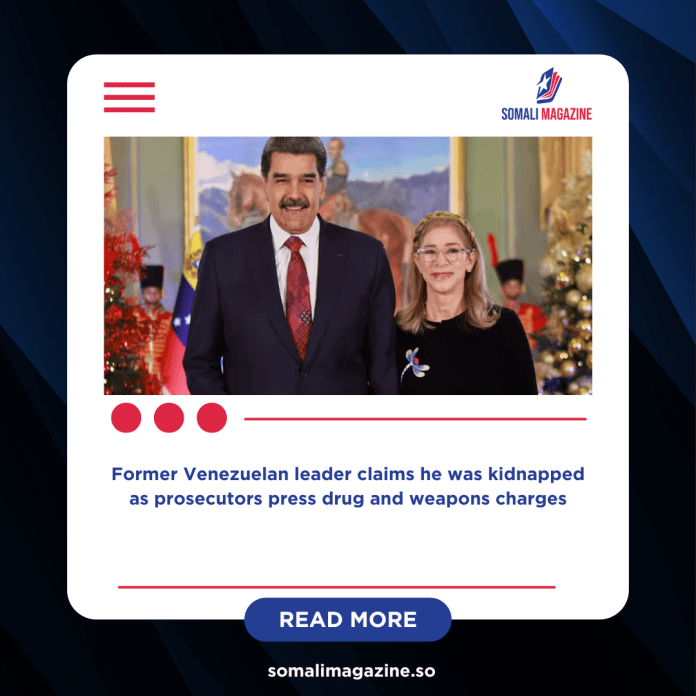
Former Venezuelan president Nicolás Maduro and his wife appeared in a New York courtroom where they both pleaded not guilty to serious drug trafficking and weapons charges brought by the United States. The high-profile court appearance marked a dramatic moment in Venezuela’s long political crisis and shifted global attention from the chaos in Caracas to the legal battle now unfolding in the US justice system.
Standing before the judge, Maduro strongly denied all accusations and claimed he had been kidnapped in Caracas and forcibly taken to the United States. He described his arrest as illegal and politically motivated, insisting that he remains the legitimate leader of Venezuela despite being removed from power. His wife echoed his plea, rejecting the charges and maintaining their innocence as the court formally opened proceedings against them.
US prosecutors accused the couple of playing a central role in a criminal network that allegedly used drug trafficking and illegal weapons deals to fund and protect Maduro’s government. The charges are part of a long-running US effort to hold Maduro and his inner circle accountable, with American officials arguing that Venezuela’s former leadership turned the state into a narco-operation. The prosecution said the case would rely on years of intelligence, witness testimony, and seized communications.
Outside the courtroom, the case quickly became a global talking point, symbolizing the downfall of one of Latin America’s most controversial leaders. Supporters of the former president described the trial as a political show designed to humiliate a sitting head of state, while critics said it represented long-delayed justice for alleged crimes committed during years of economic collapse and repression in Venezuela.
As Maduro and his wife faced the judge in New York, tension rose back home in Caracas. Reports of gunfire and anti-aircraft fire briefly spread across the capital, prompting fears of unrest following Maduro’s removal. Venezuelan authorities later said police had fired at unauthorized drones flying near sensitive government sites and insisted the situation was under control. Local accounts suggested the gunfire may have resulted from confusion between different security units rather than an organized uprising.
The uncertainty in Venezuela has only deepened since Maduro’s arrest. Delcy Rodríguez, a close ally of the former president, was sworn in as acting president, a move that has sparked criticism from opposition groups and raised questions about whether real political change is possible. Meanwhile, US President Donald Trump has repeatedly claimed that the United States is now guiding Venezuela’s transition, statements that have drawn both support and concern internationally.
Maduro’s courtroom plea also reignited debate over how the United States has handled Venezuela’s opposition. Some former US officials argue Washington should have worked more closely with opposition leaders rather than engaging with figures linked to the previous regime. Opposition leader María Corina Machado praised Maduro’s arrest as a historic moment but said she has had limited contact with the Trump administration in recent months.
For many Venezuelans, the image of Maduro and his wife standing before a US judge was unthinkable just weeks ago. Once a powerful leader who ruled with a firm grip on the military and state institutions, Maduro now faces the prospect of a lengthy legal fight far from home. The outcome of the case could shape not only his personal future but also Venezuela’s fragile political path.
As the trial moves forward, attention will remain fixed on the New York courtroom where Maduro insists he was kidnapped, while prosecutors prepare to argue that his reign was built on crime. For a nation already exhausted by years of crisis, the proceedings may finally mark the end of an era — or the beginning of an even more uncertain chapter.