Facebook

Twitter (X)

Instagram

Somali Magazine - People's Magazine
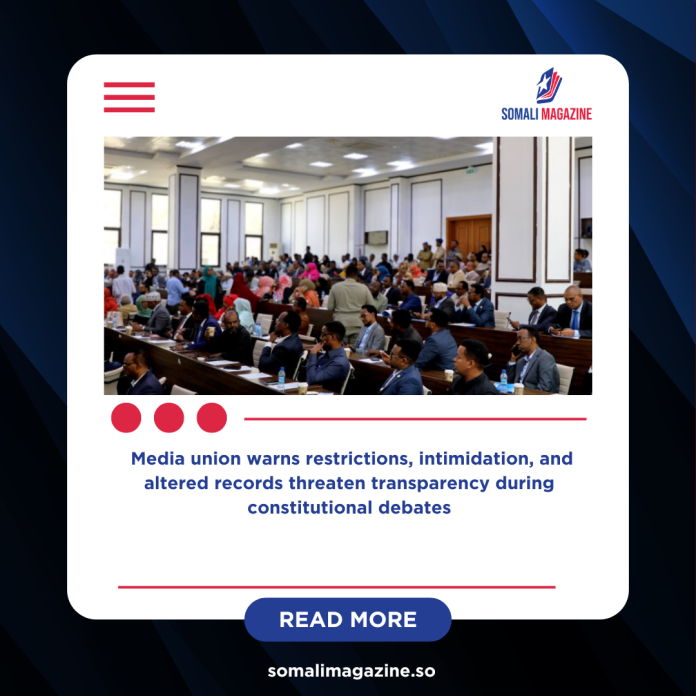
The National Union of Somali Journalists (NUSOJ) has raised serious concerns over what it describes as growing restrictions on media freedom inside Somalia’s federal parliament. The union accuses parliamentary leaders of deliberately blocking journalists from covering constitutional debates and interfering with how parliamentary proceedings are presented to the public, actions it says undermine transparency and democratic accountability.
In a statement released on Monday, NUSOJ said journalists have increasingly been denied access to parliament, intimidated, and removed from the premises for reporting on disorder and disagreements during recent sessions. According to the union, these actions go beyond normal administrative decisions and instead point to a deliberate effort to silence independent reporting.
NUSOJ said the situation first escalated on January 28, 2026, when three female journalists were stopped from entering the House of the People. The journalists—Nimo Muhudiin Ardofe of Somali Cable TV, Amina Ibrahim Abdirahman of Arlaadi TV, and Rowda Hassan Taakile of Goobjoog TV—were reportedly targeted after sharing video clips on their personal Facebook pages showing chaos and heated exchanges during constitutional discussions.
The union described this as a clear act of intimidation, warning that punishing journalists for sharing factual events sends a dangerous signal to the entire media community. It said such actions create fear and discourage reporters from covering sensitive but important national issues.
According to NUSOJ, the restrictions did not stop there. On February 2, the same journalists were again denied entry by parliamentary officials and security personnel. Journalists who were already inside the building were reportedly ordered to leave, effectively shutting down live coverage of unfolding disputes. By February 7, NUSOJ said, journalists as a group were expelled from parliament, marking a significant escalation in the crackdown.
The union said it formally protested these actions in a letter addressed to the Speaker of the House of the People, Sheikh Adan Mohamed Nur, demanding an immediate end to what it termed unlawful restrictions on the press. Although the three female journalists were later allowed back into parliament, NUSOJ noted that no public apology or acknowledgment of wrongdoing was issued, and the broader concerns were left unaddressed.
Beyond physical access, NUSOJ expressed alarm over reports that technology was used to manipulate the public record of parliamentary sessions. During one particularly tense debate marked by shouting, whistles, and protests, the union said artificial intelligence-based audio tools were applied to filter out surrounding noise while amplifying the official speaker’s voice.
While such tools are commonly used to reduce background noise, NUSOJ argued that in this case the “background” included legitimate expressions of dissent and disruption that form part of parliamentary debate. By removing these sounds, the public was presented with an edited version of events that erased visible tension and resistance inside the chamber.
The union warned that this practice distorts reality and weakens public trust. Parliamentary debates, it said, are not defined only by prepared speeches but also by disagreements, interruptions, and political contestation. Removing these elements presents a misleading image of calm and consensus that does not reflect what actually occurred.
NUSOJ said the increasing use of technology to reshape political information poses a broader threat to democratic transparency. It called for unrestricted access for journalists, an end to political interference in media work, and firm guarantees that no administrative or technological tools will be used to alter factual records.
“Media freedom, equal access, and truthful documentation are not privileges,” the union said. “They are essential responsibilities at the heart of democratic governance.”
The statement comes as Somalia’s federal parliament concluded debates on Chapter Four of the Provisional Constitution, which addresses the federal system, relations between the central government and member states, and the division of powers—issues that remain highly contested and of deep national importance.