
Facebook

Twitter (X)

Instagram

Somali Magazine - People's Magazine
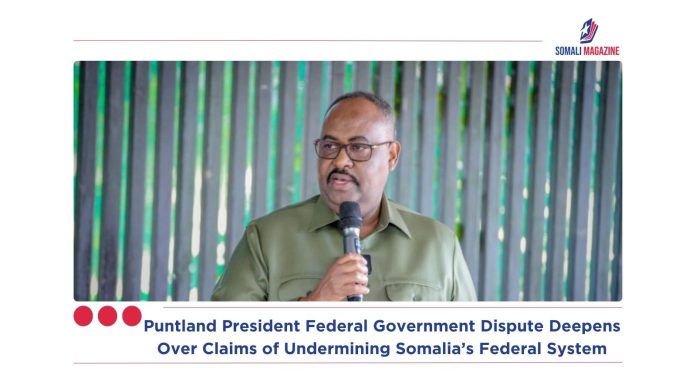
The Puntland President federal government dispute has escalated sharply after Said Abdullahi Deni accused Somalia’s federal leadership of undermining the country’s federal system, deepening existing political tensions between regional and central authorities. The remarks highlight ongoing disagreements over governance, power-sharing, and the future structure of the Somali state.
Speaking from Puntland, President Deni criticised the federal government based in Mogadishu, alleging that recent decisions have weakened the autonomy of federal member states. He argued that such actions risk reversing the progress made toward establishing a balanced federal framework, which was designed to distribute power more equitably across the country after years of centralised rule.
At the centre of the Puntland President federal government dispute is the interpretation and implementation of Somalia’s provisional constitution. Regional leaders have long maintained that the federal system should guarantee significant autonomy in areas such as security, resource management, and local governance. However, tensions have periodically surfaced when federal authorities attempt to assert greater control over national policies.
The Somalia federal system, adopted as part of post-conflict reconstruction efforts, was intended to accommodate the country’s complex clan dynamics and regional diversity. While it has helped stabilise parts of the country, its practical implementation has often been marked by disputes over jurisdiction and authority. Analysts note that these disagreements are not new but have intensified in recent years amid broader political reforms and security challenges.
Officials from the federal government have not publicly accepted the accusations, instead emphasising the need for national unity and coordinated governance. They argue that stronger central institutions are essential for addressing security threats, including the ongoing fight against Al-Shabaab, and for ensuring consistent policy implementation across all regions.
The Puntland autonomy debate reflects a wider concern among federal member states Somalia is composed of, many of which have voiced similar reservations about perceived centralisation. Political observers suggest that unresolved tensions could affect cooperation on key national priorities, including elections, security coordination, and economic development.
Despite the sharp rhetoric, there have been calls from both sides for dialogue and negotiation. Diplomatic channels and intergovernmental forums are often used to address such disputes, though progress can be slow due to competing interests and differing interpretations of constitutional provisions.
The Puntland President federal government dispute underscores the fragile balance that defines Somalia’s governance model. As the country continues to rebuild institutions and strengthen its political framework, the relationship between federal and regional authorities remains a critical factor in determining long-term stability.
For many citizens, the outcome of these tensions carries significant implications, influencing everything from local governance to national policy direction. Whether through negotiation or reform, the resolution of these disputes will play a key role in shaping the future of Somalia’s federal system.