
Facebook

Twitter (X)

Instagram

Somali Magazine - People's Magazine
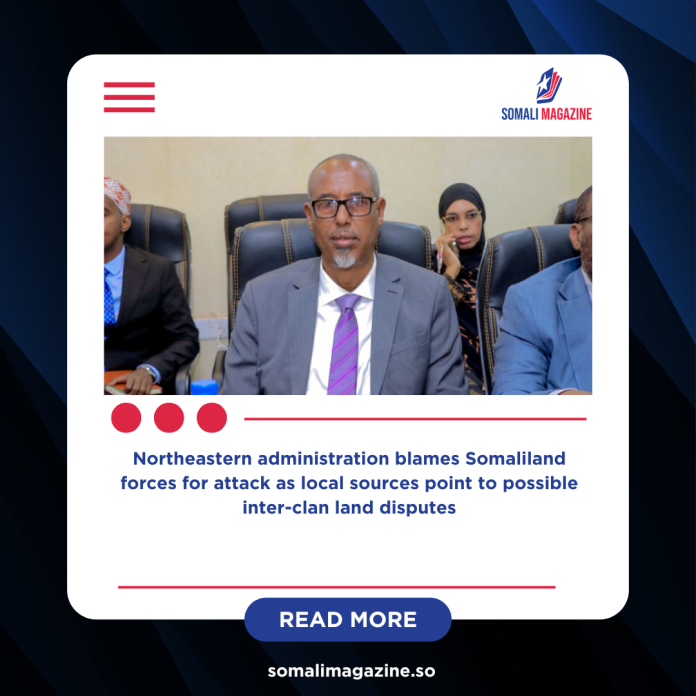
Tensions have risen once again in the Sanaag region after the Northeastern regional administration accused Somaliland forces of carrying out an attack in the Waqdariya area, located under the Lasqoray district. In a statement released on Thursday, the region’s Ministry of Security said the attack happened at around 8:30 a.m. and targeted civilians living in the area.
According to the administration, the incident led to deaths and injuries, although officials did not provide specific numbers. The statement described the attack as part of a series of repeated clashes in Sanaag, which it blamed on Somaliland authorities. It said communities living near the border areas have been facing ongoing insecurity and claimed that such incidents have become frequent.
The administration strongly condemned the violence and vowed to defend its territory. Officials warned that those responsible for the attack would be held accountable. The statement reflected growing frustration over what the region sees as continuous instability affecting residents in disputed areas.
Waqdariya lies in a part of Sanaag that has long experienced tensions due to overlapping territorial claims and local rivalries. Sanaag itself has been a sensitive region for years, with different administrations asserting control over certain districts. This has often led to political disagreements and occasional armed confrontations.
However, independent reports from people familiar with the situation suggest that the violence may not be solely political. Local sources say the latest clashes could be linked to inter-clan fighting rooted in long-standing disputes over land ownership and grazing boundaries. In rural parts of Sanaag, access to pasture and water is essential for livelihoods, especially for pastoralist communities who depend on livestock. Disagreements over these resources can quickly escalate if not properly managed.
Residents in Waqdariya have reportedly been experiencing rising tensions between two clans in recent days. Community elders and local leaders are said to be aware of the dispute, though it remains unclear whether formal mediation efforts were underway before the violence broke out. In many parts of Somalia and Somaliland, traditional elders often play a key role in resolving such conflicts through dialogue and customary law. When these mechanisms fail or are delayed, disputes can turn violent.
As of now, Somaliland authorities have not issued an official response to the accusations made by the Northeastern administration. The absence of a public statement has left many questions unanswered about what exactly triggered the fighting and who was directly involved.
The situation in Waqdariya remains tense. Residents are said to be worried about the possibility of further clashes if calm is not restored soon. In areas already struggling with limited services and fragile security, renewed violence can disrupt daily life, force families to flee, and deepen mistrust among communities.
Observers say that without serious efforts toward dialogue and conflict resolution, tensions in Sanaag could continue to flare up. Whether the root cause is political rivalry, territorial claims, or inter-clan disputes over land and grazing rights, sustainable peace will likely depend on open communication, mediation, and cooperation between local leaders and regional authorities.
For now, communities in Waqdariya and the wider Sanaag region are watching closely, hoping that steps will be taken to prevent further bloodshed and restore stability in the area.