Facebook

Twitter (X)

Instagram

Somali Magazine - People's Magazine
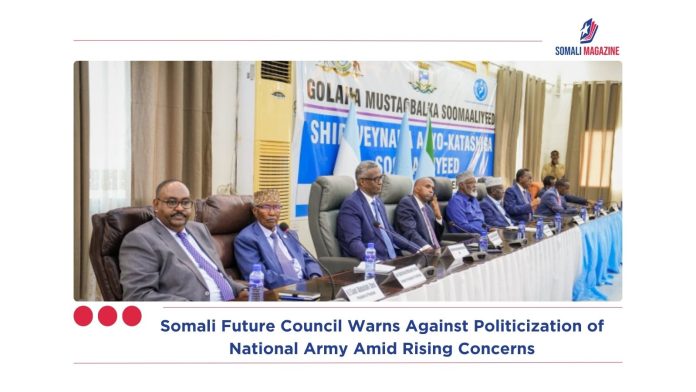
The statement that the Somali Future Council warns politicization national army has sparked renewed debate over the role of the military in Somalia’s evolving political landscape. The council’s warning highlights growing concerns that the country’s armed forces could be drawn into political disputes, potentially undermining stability and public trust.
In its remarks, the Somali Future Council emphasised the importance of maintaining a professional and non-partisan military. The group cautioned that any perception of political alignment within the armed forces could weaken national unity and disrupt ongoing efforts to strengthen security institutions across Somalia.
The Somali Future Council warns politicization national army at a time when Somalia continues to navigate complex political transitions, including federal-state relations and electoral processes. Analysts note that the military has played a critical role in counterterrorism operations and stabilisation efforts, making its neutrality essential for long-term peacebuilding.
Experts in civil-military relations Somalia stress that maintaining clear boundaries between political leadership and military command is fundamental to democratic governance. In fragile states, the politicisation of security forces can lead to fragmentation, reduced operational effectiveness, and increased risk of internal conflict.
The council’s statement also comes amid broader Somalia security governance challenges, where efforts to reform institutions are ongoing. International partners have long supported initiatives aimed at professionalising the Somali National Army, including training, capacity building, and accountability mechanisms. These efforts are designed to ensure that the military serves the nation rather than specific political interests.
Observers point out that Somalia national army politics has historically been a sensitive issue, shaped by past experiences where divisions within security forces contributed to instability. As a result, maintaining military neutrality Somalia remains a priority for both domestic stakeholders and international allies.
Government officials have not directly responded to the council’s warning, but previous statements have consistently emphasised the importance of a unified and disciplined armed force. Ensuring that the military remains focused on its core mandate—defending the country and protecting civilians—remains central to national security objectives.
The Somali Future Council warns politicization national army as part of a broader call for responsible leadership and institutional integrity. By urging restraint and adherence to constitutional principles, the council aims to prevent potential tensions from escalating into larger challenges.
For many observers, the issue reflects a critical moment in Somalia’s state-building journey. Balancing political development with strong, independent institutions will be key to sustaining progress. The role of the military, in particular, will continue to shape the country’s trajectory in the years ahead.
As Somalia works toward stability and growth, the message from the Somali Future Council serves as a reminder that safeguarding the neutrality of national institutions is essential. The future of the country’s security framework may well depend on the ability to keep politics and the military firmly separated.