
Facebook

Twitter (X)

Instagram

Somali Magazine - People's Magazine
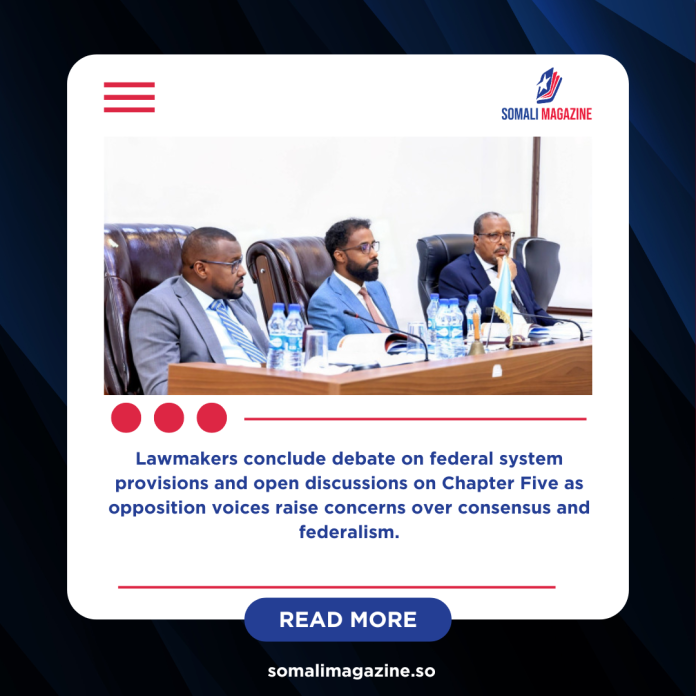
Somalia’s federal parliament on Monday moved forward with its long-running constitutional review by concluding debate on Chapter Four of the Provisional Constitution and officially opening discussions on Chapter Five. The step marks another milestone in a process that has taken years to advance and continues to stir sharp political disagreements across the country.
The joint session of the two parliamentary chambers was held at the House of the People headquarters in Mogadishu and formed part of the 12th joint meeting of parliament. During the session, lawmakers finalized deliberations on proposed changes to Chapter Four, which focuses on the federal system of governance. Much of the discussion centered on Articles 49, 50, and 54, key provisions that outline the structure of federal member states, define the relationship between the federal government and regional administrations, and explain how powers and responsibilities are divided.
Supporters of the review argue that clarifying these articles is necessary to strengthen governance, reduce institutional confusion, and complete Somalia’s constitutional framework. They believe that unresolved constitutional gaps have contributed to repeated political disputes and weakened cooperation between the federal government and member states.
The session was jointly chaired by senior parliamentary leaders, reflecting the importance attached to the proceedings. After wrapping up the Chapter Four debate, lawmakers formally began reviewing Chapter Five, signaling the continuation of the second phase of the constitutional revision process. Parliamentary leaders confirmed that discussions on Chapter Five will continue in upcoming sessions, suggesting that the process is far from over and may become even more complex.
However, the session took place amid visible political tension. Twenty-five lawmakers who were previously suspended from joint parliamentary sittings did not attend the meeting. The suspensions followed accusations that the MPs had disrupted earlier sessions. On Sunday night, the suspended lawmakers publicly restated their opposition to any changes to the Provisional Constitution, warning parliamentary leadership against pushing forward without wide political agreement.
These lawmakers argue that constitutional amendments should only proceed through broad consensus and a shared national vision. According to them, altering the constitution without inclusive dialogue risks deepening political divisions and undermining trust in state institutions. They insist that all major political actors, including federal member states and opposition groups, must be fully involved in shaping any changes.
The constitutional review has emerged as one of the most divisive issues in Somali politics. Opposition figures and some federal member states, notably Puntland and Jubbaland, have expressed strong reservations about the proposed amendments. Their main concern is that the changes could shift too much authority to the central government, weakening the federal system that was designed to balance power between Mogadishu and the regions.
On the other hand, the federal government maintains that the reforms are critical for completing the constitution and stabilizing governance. Officials argue that the Provisional Constitution was never intended to be permanent and that unresolved constitutional questions have repeatedly triggered political crises, delayed elections, and slowed state-building efforts.
As parliament turns its attention to Chapter Five, expectations are that debates will become more intense. The coming sessions will test whether lawmakers can manage deep disagreements while keeping the review process on track. The outcome of these discussions is likely to shape Somalia’s political future, influence relations between the federal government and member states, and determine whether the country can finally conclude a constitutional process that has been in limbo for more than a decade.