
Facebook

Twitter (X)

Instagram

Somali Magazine - People's Magazine
Somali pastoralists are increasingly embracing modern livestock practices as they look for better ways to protect their animals, increase productivity, and earn more reliable incomes. In Galmudug’s Adado district, herders are learning how feedlots and cultivated fodder can help them move beyond dependence on open grazing, which has become more unpredictable due to frequent droughts and climate shocks.
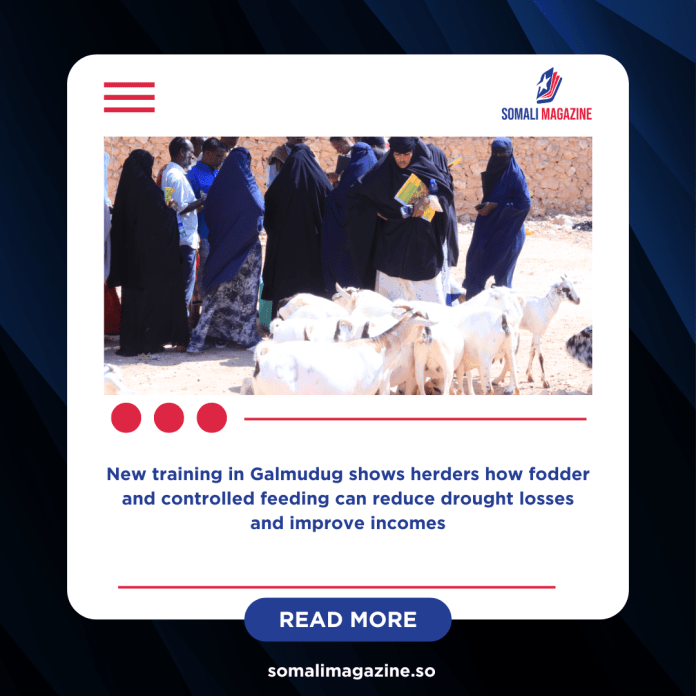
From December 9 to 13, pastoralists from different parts of Galmudug gathered in Adado for a five-day hands-on training focused on feedlot management, controlled feeding, fodder production, and basic animal health. The training was organized under a national program led by the Ministry of Livestock, Forestry and Range, with support from the World Bank–funded Horn of Africa DRIVE Somalia project. The goal was to turn policy and investment into practical skills that herders can use immediately in their daily work.
Participants learned how to grow fodder crops, store animal feed, and manage livestock in feedlots, especially during dry seasons when natural pasture becomes scarce. For many, the training marked a major shift in how they view livestock production. Instead of moving animals long distances in search of grazing, herders were shown how controlled feeding can keep animals healthy, help them gain weight faster, and make them ready for sale when market prices are highest.
Layla Dahir Hussain, a livestock farmer from Adado, said the training opened her eyes to new possibilities. She explained that producing fodder and using feedlots allows animals to remain strong even when grazing lands fail. According to her, healthier and heavier animals attract better prices, improving household income and reducing losses during hard times.
Livestock remains the backbone of Somalia’s economy, accounting for roughly 80 percent of export earnings. Because of this, the government has placed strong emphasis on improving productivity, animal health, and compliance with export standards. Feedlots supported by cultivated fodder are seen as a practical solution, allowing producers to maintain consistent quality throughout the year and reduce the impact of seasonal market fluctuations.
Officials involved in the program say feedlots are not just about faster weight gain. They also serve as an important tool for drought preparedness. When pastures dry up, feedlots provide a way to keep animals alive and in good condition, helping herders avoid selling livestock at very low prices or losing them altogether. This approach gives pastoralists more control over when and how they sell their animals.
Dr. Aden Hussein Derow, Director of Animal Production and Research at the ministry, said the shift toward feedlots and fodder production is essential for the future of Somalia’s livestock sector. He noted that the country is gradually moving from purely traditional grazing systems toward a more resilient and market-focused model. Alongside feedlot development, the HoA DRIVE project is supporting wider reforms, including livestock identification and traceability, improved veterinary laboratories, and digital export health certification. Together, these efforts aim to strengthen disease control, food safety, and trust in Somali livestock in regional and international markets.
The training in Adado was delivered by Calaf Group, a Somali company specializing in livestock development. Its managing director, Ahmed Yasin, said the focus is on helping pastoralists plan production around market demand rather than simply reacting to drought. He emphasized that consistent quality and supply are critical for export growth.
As similar trainings expand to other regions, authorities hope to link better feeding practices with access to finance, animal health services, and traceability systems. This combined approach is expected to support job creation, stable rural incomes, and long-term growth in livestock exports.
For participants, the impact is already personal and clear. Mohamud Abdullahi Galbayte, an agropastoralist from Adado, said the training made him realize that proper feeding and fattening can transform the dry season from a time of fear into a manageable challenge. With new knowledge and confidence, many pastoralists are returning home convinced that Somalia’s traditional pastoral economy is changing, and that they can be part of a more secure and productive future.