
Facebook

Twitter (X)

Instagram

Somali Magazine - People's Magazine
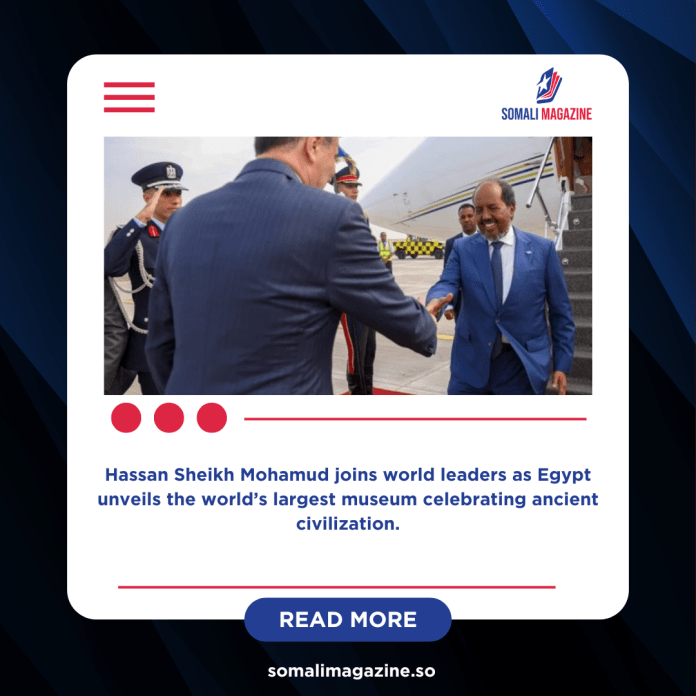
Somali President Hassan Sheikh Mohamud joined world leaders on Saturday for the grand opening of Egypt’s new Grand Egyptian Museum — the largest archaeological museum ever built to celebrate a single civilization. The event, held at the foot of the Giza Plateau, was inaugurated by Egyptian President Abdel Fattah el-Sisi and attended by delegations from 79 countries, including 39 led by kings, princes, and heads of state and government.
The ceremony featured a spectacular musical performance against the backdrop of the pyramids, marking a historic moment for Egypt’s cultural heritage. During his visit, President Mohamud is expected to highlight the deep historical and cultural ties between Somalia and Egypt, underscoring the two nations’ shared interest in preserving their civilizations and strengthening bilateral relations.
The idea for the Grand Egyptian Museum was first introduced in the 1990s by then–Culture Minister Farouk Hosni, who envisioned an open museum complex linking the pyramids, the Sphinx, and nearby temples. Former President Hosni Mubarak laid the foundation stone in 2002, with site preparation starting in 2005. However, the project faced several delays due to funding and political challenges.
Construction resumed in 2014 under President Sisi, who expanded the original plan into what has now become a monumental symbol of Egypt’s cultural revival. Over the next decade, the project evolved into the world’s largest museum dedicated entirely to the ancient Egyptian civilization. Between 2017 and 2023, Egypt completed construction, exhibition design, digital infrastructure, and visitor facilities. The museum began limited trial operations in October 2024, welcoming select visitors to preview some of its remarkable collections.
Situated just two kilometers from the Giza Pyramids, the Grand Egyptian Museum covers an impressive 490,000 square meters. Its design combines modern architecture with Egypt’s ancient legacy, featuring a five-story glass façade that offers panoramic views perfectly aligned with the Great Pyramid. Inside, visitors can explore more than 100,000 artifacts that tell the story of Egypt’s history — from the early dynasties to the golden age of the pharaohs.
Among its treasures is the complete collection of King Tutankhamun’s artifacts, many of which will be displayed together for the first time since their discovery over a century ago. The museum also includes research facilities, educational centers, restaurants, and open spaces designed to provide an immersive experience for both scholars and tourists.
The $1 billion project was financed largely through two Japanese loans totaling $800 million, along with contributions from the Egyptian government, international partners, and public donations. Beyond its cultural significance, the museum is expected to become a major global attraction, boosting Egypt’s tourism industry and reinforcing its position as a guardian of ancient history.
For Egypt, the opening of the Grand Egyptian Museum marks the fulfillment of a decades-long dream — one that bridges the ancient past with a modern vision of cultural pride. For visiting leaders like President Mohamud, it also represents an opportunity to celebrate shared heritage and cooperation among nations that value history, identity, and progress.