Facebook

Twitter (X)

Instagram

Somali Magazine - People's Magazine
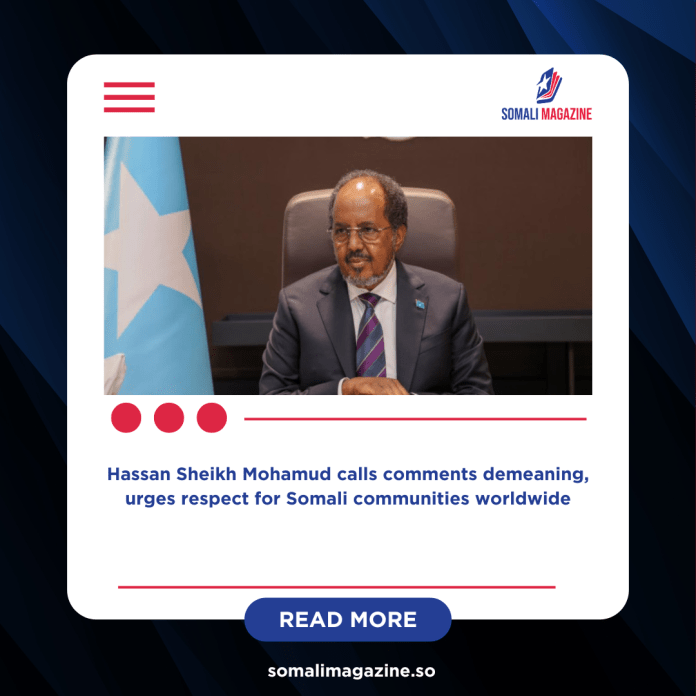
Somali President Hassan Sheikh Mohamud has strongly condemned remarks attributed to former U.S. President Donald Trump that described Somalis as “garbage,” calling the language deeply offensive and unfair to an entire nation and its people. Speaking in an interview with Al Arabiya English, Mohamud said such statements are unacceptable and undermine the dignity of millions of Somalis around the world.
The president stressed that Somalis are hardworking, intelligent, and capable people who contribute positively wherever they live. He said using demeaning language to describe an entire community only reinforces harmful stereotypes and ignores the real contributions Somali communities have made globally, including in the United States. According to Mohamud, words spoken by influential leaders carry weight and can cause fear, division, and misunderstanding, especially among immigrant communities.
Mohamud noted that Somalia values its long-standing relationship with the United States, particularly in areas such as security cooperation and counterterrorism. However, he emphasized that mutual respect must be at the center of any partnership. While acknowledging the importance of collaboration between Washington and Mogadishu, the president made it clear that respect for Somali people should never be compromised, regardless of political debates within the U.S.
The remarks attributed to Trump reportedly came during a discussion about alleged large-scale fraud involving social assistance programs in Minnesota. Trump allegedly linked the issue to Somali immigrants and warned that the United States would “go the wrong way” if it continued to accept what he described as “garbage.” These comments sparked strong reactions from Somali leaders and diaspora communities, who said the statements unfairly blamed an entire group for the actions of a few individuals.
Mohamud rejected what he described as broad and unjustified generalizations. He pointed out that isolated criminal cases should never be used to label a whole community. Millions of Somalis, he said, live law-abiding lives and make meaningful contributions as workers, business owners, professionals, and community leaders in their host countries. In the United States alone, Somali-Americans have played important roles in education, healthcare, business, and public service.
On the issue of immigration, the Somali president said that Somalis who are legally living in the United States should be allowed to remain without fear. At the same time, he acknowledged that matters involving undocumented migrants fall under U.S. law and the authority of American institutions. Somalia, he said, respects the sovereignty of other nations when it comes to enforcing their immigration policies, but this should be done in a fair and humane manner.
Somali communities in the United States are among the largest outside the Horn of Africa, with significant populations in states such as Minnesota, Ohio, and Washington. Minnesota, in particular, is home to the largest Somali-American community in the country. Local leaders there have said the remarks have increased anxiety and fear, especially among families who worry about being targeted or stigmatized.
The controversy also comes at a time when cooperation between Somalia and the United States remains critical, especially in the ongoing fight against the militant group al-Shabab. Somali officials and diaspora leaders have warned that inflammatory rhetoric targeting entire communities risks damaging social cohesion and could undermine international cooperation at a time when unity is needed most.
President Mohamud concluded by urging leaders to choose their words carefully and to avoid language that dehumanizes others. He said respect, understanding, and fairness are essential for maintaining strong international relationships and peaceful multicultural societies.