
Facebook

Twitter (X)

Instagram

Somali Magazine - People's Magazine
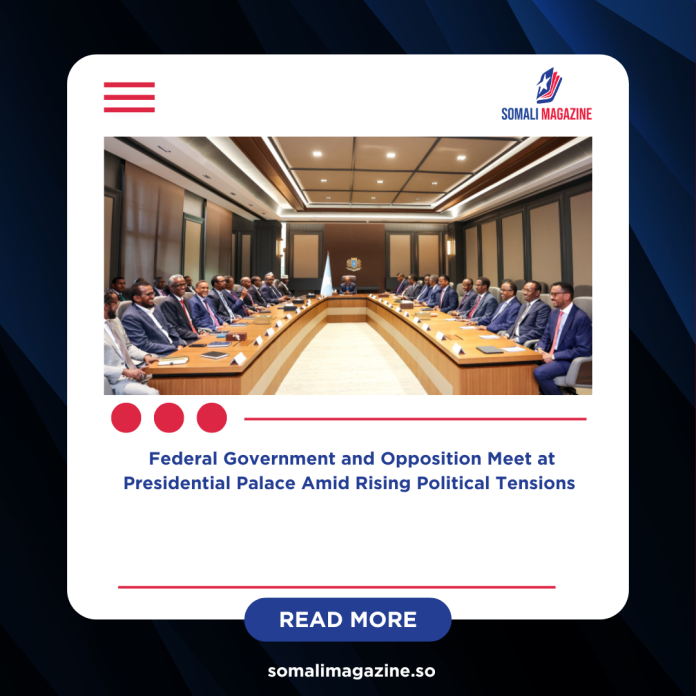
Hassan Sheikh Mohamud on Thursday led a high-level meeting at the Presidential Palace in Mogadishu, bringing together senior federal government officials and leaders from the Somali Future Council. The gathering officially launched a consultative conference aimed at addressing growing disagreements over upcoming elections and proposed constitutional reforms.
The talks come at a critical time, with less than three months remaining in the current government’s term. Political tensions have been rising in recent weeks, fueled by disputes over how the next elections should be conducted and how changes to the constitution should be handled. Both sides have acknowledged the need for dialogue to avoid further uncertainty.
In a brief statement, Villa Somalia said the president chaired discussions focusing on the country’s overall political situation, preparations for elections, strengthening national unity, addressing the ongoing drought crisis, and continuing the fight against what the government refers to as “Khawarij,” its term for the militant group al-Shabab. While security and humanitarian issues were discussed, the main focus of the conference is on reaching common ground over the electoral process and constitutional amendments.
Officials involved in organizing the meeting said the first sessions are meant to establish a clear agenda and timeline for negotiations. A structured approach is expected to guide the discussions, especially on unresolved questions surrounding the electoral framework. Key issues include whether the country is ready to move toward direct, one-person, one-vote elections and how recently proposed constitutional changes should be finalized.
The conference follows an agreement reached earlier in the week between the federal government and the Somali Future Council, an opposition alliance that includes leaders aligned with regional administrations such as Puntland and Jubbaland. After days of consultations, both sides agreed to hold formal talks at the presidential palace. The opposition accepted President Hassan Sheikh’s invitation to meet at Villa Somalia, signaling a willingness to engage in dialogue despite deep differences.
Justice Minister Hassan Moalim, who heads the organizing committee for the conference, emphasized before the opening session that the government’s top priority remains the introduction of one-person, one-vote elections. The federal leadership has repeatedly stated that Somalia must transition from indirect electoral systems toward a more democratic model in which citizens directly choose their leaders.
However, opposition figures have expressed concern about both the speed and the substance of the constitutional amendments currently being debated in parliament. They argue that significant changes should not be rushed without broader consensus and public consultation. Some leaders fear that pushing reforms without agreement could create a political vacuum once the current term ends.
The opposition has also called for a negotiated electoral arrangement that would ensure stability and avoid institutional deadlock. They stress the importance of inclusivity and compromise, warning that unilateral decisions could deepen divisions between the federal government and regional states.
Despite the tensions, the start of formal talks has been welcomed by many as a positive step. Both the government and the opposition have publicly signaled their readiness to compromise in order to safeguard national unity and prevent further political uncertainty. Observers say the coming days will be crucial in determining whether the two sides can bridge their differences and agree on a roadmap for elections and constitutional reform.
As discussions continue, Somalis across the country are watching closely. The outcome of this conference could shape not only the next election cycle but also the broader direction of governance and democratic development in Somalia.