
Facebook

Twitter (X)

Instagram

Somali Magazine - People's Magazine
The Somali government has announced plans to hire 10,000 new teachers over the next 45 months in a major effort to rebuild the country’s education system. Prime Minister Hamza Abdi Barre said the move is part of a larger plan to strengthen public services and help Somalia become more self-reliant.
Speaking on Friday, the Prime Minister described education reform as a top national priority. He said investing in teachers is not only about improving schools but also about building a stronger and more stable nation. According to him, the recruitment drive is a key step toward restoring government institutions and promoting long-term economic growth.
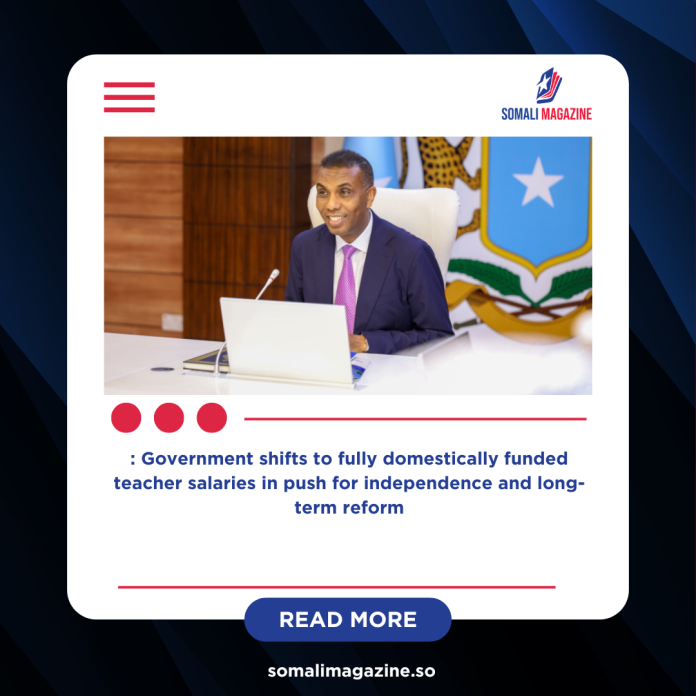
One of the most significant changes announced is how teachers will be paid. For the first time in Somalia’s history, teachers’ salaries will be fully covered by domestic revenue instead of foreign donors. Barre said this marks an important shift toward financial independence. He called it a matter of national pride and practical self-reliance, emphasizing that Somalia is beginning to fund its essential services using its own resources.
When the current administration came into office, official records showed that only around 900 teachers were receiving salaries directly from the federal government. Since then, thousands of trained teachers have reportedly been recruited and deployed across the country. Many of them have been sent to remote and underserved areas where access to education has long been limited.
The new plan aims to build on that progress by significantly increasing the number of teachers in public schools. However, the Prime Minister acknowledged that the country still faces a large gap in meeting its education needs. Estimates suggest Somalia will ultimately require about 120,000 teachers to adequately serve its growing population. While the planned 10,000 new hires represent an important step forward, they cover only a fraction of the overall demand.
In addition to teacher recruitment, the government also plans to hire up to 12,000 civil servants by 2026 as part of broader public sector reforms. Officials say these measures are designed to strengthen state institutions and improve service delivery across different sectors.
Somalia’s education system has faced serious challenges for decades. Years of conflict, political instability, and weak institutions severely damaged public infrastructure. As a result, many communities relied heavily on private schools, local initiatives, and international donors to provide basic education. In some areas, access to formal schooling has remained limited, especially in rural regions.
Education experts say that while hiring more teachers is a crucial step, it is only one part of the solution. They note that lasting progress will also require investment in school buildings, learning materials, teacher training, curriculum development, and stronger management systems. Without these supporting measures, expanding the workforce alone may not fully address the system’s challenges.
Still, the government’s announcement signals a clear intention to take greater responsibility for essential public services. By shifting teacher salaries to domestic funding, Somalia is attempting to reduce reliance on external aid and strengthen its financial systems. The move aligns with ongoing fiscal reforms aimed at improving revenue collection and increasing government accountability.
For many families, the recruitment plan offers hope that access to quality education will improve in the coming years. Expanding the number of teachers, especially in underserved communities, could help reduce classroom overcrowding and ensure that more children have consistent access to learning.
While challenges remain, the government’s plan represents a significant effort to rebuild one of the country’s most critical sectors. Education is widely seen as the foundation for economic opportunity, social stability, and national development. By investing in teachers and committing domestic resources to pay them, Somalia is signaling a long-term commitment to strengthening its future.