
Facebook

Twitter (X)

Instagram

Somali Magazine - People's Magazine
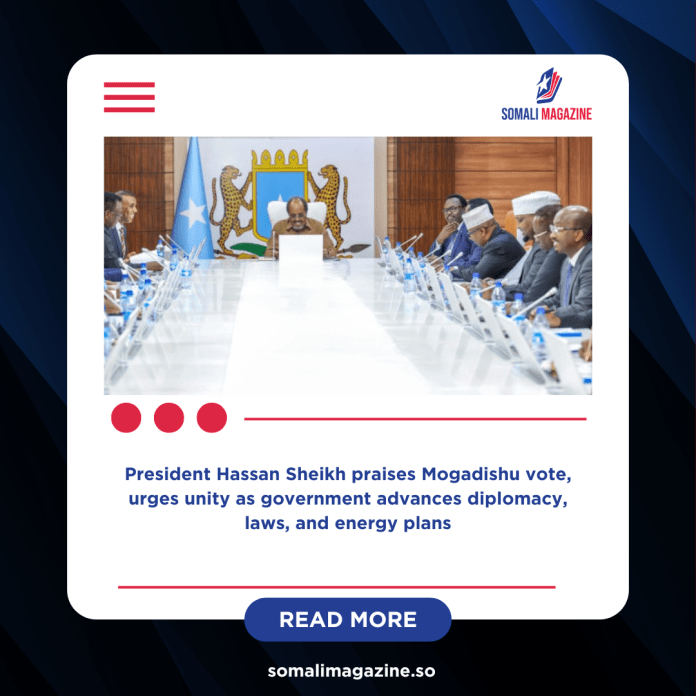
Somalia’s Council of Ministers convened an extraordinary meeting in Mogadishu on Monday to take stock of the country’s security situation, review recent military operations against extremist groups, and acknowledge the completion of local council elections in the Banadir region. The session was chaired by President Hassan Sheikh Mohamud and attended by Prime Minister Hamza Abdi Barre, highlighting the importance the government placed on the discussions at a time when Somalia is navigating complex security, political, and diplomatic challenges.
During the meeting, President Hassan Sheikh briefed the Cabinet on the overall national situation, focusing on both internal developments and external pressures. He commended ministers for what he described as their active and effective role in ensuring the success of Mogadishu’s local elections, which were held on December 25, 2025. The president described the vote, conducted under a one-person, one-vote system, as a historic achievement for the capital and the country at large. He noted that many observers had previously doubted such an election could be carried out in Mogadishu due to longstanding security concerns, but said the successful process demonstrated growing political maturity and improved stability.
The president also used the meeting to address what he termed a direct assault on Somalia’s sovereignty. Without naming specific countries, he told ministers that the government had already taken concrete diplomatic steps in response and had seen measurable results. He urged Cabinet members to remain united and vigilant in defending Somalia’s territorial integrity, stressing that cohesion, consultation, and shared responsibility were essential as the country faces sensitive national issues. His remarks came amid heightened public concern over recent regional developments that many Somalis view as challenging the country’s unity and international standing.
In this context, Israel’s decision to recognize Somaliland was referenced as a source of strong reactions within Somalia and beyond. Critics across the country and the wider Horn of Africa have argued that the move violates international law and risks increasing regional instability. While the Cabinet did not dwell extensively on the issue during the meeting, the broader diplomatic environment formed part of the backdrop to the president’s call for unity and a firm national position.
Beyond security and sovereignty matters, the Cabinet moved forward with efforts to strengthen Somalia’s international partnerships. Ministers approved two memoranda of understanding aimed at enhancing cooperation with key allies. One agreement focuses on security cooperation with Uganda, reflecting ongoing collaboration in the fight against extremist groups and in regional stability efforts. The second agreement covers maritime transport cooperation with Saudi Arabia, a partnership seen as important for trade, port development, and Somalia’s growing engagement in the Red Sea and Gulf of Aden shipping corridors.
The meeting also advanced the government’s legislative agenda, with ministers endorsing several draft laws and national policies. Among the approved measures were the Evidence Bill, new regulations linked to the Public Data Protection Law, and the National Policy on Persons with Disabilities, which aims to improve inclusion and access to services for vulnerable communities. The Cabinet also approved the ratification of the International Convention on Standards of Training, Certification and Watchkeeping for Seafarers of 1978, as well as legislation establishing the Somali Maritime Institute. These steps were presented as part of broader efforts to modernize state institutions, improve governance, and align Somalia with international standards.
Economic development featured prominently in the discussions. Petroleum and Minerals Minister Dahir Shire Mohamed briefed ministers on preparations for the start of oil production in Somalia, a sector the government considers crucial for long-term revenue generation and national development. While details remain limited, the Cabinet was informed of ongoing planning and coordination efforts to ensure the sector is developed responsibly.
Ministers also received an update from the National Disaster Management Agency (SODMA) on worsening drought conditions affecting several parts of the country. The briefing highlighted the need for continued humanitarian preparedness and coordinated responses to protect vulnerable communities as climate-related challenges intensify.
Looking ahead, the Cabinet noted upcoming international cooperation in the energy sector. Turkey is expected to deploy a drilling vessel to Somali waters in February as part of its first deepwater energy exploration project abroad. According to Turkish officials, the operation will focus on offshore areas within Somalia’s territorial waters, though specific details on potential reserves have not been disclosed. The development was cited as another sign of Somalia’s increasing engagement with international partners as it seeks to unlock its natural resources while addressing pressing security and governance priorities.