
Facebook

Twitter (X)

Instagram

Somali Magazine - People's Magazine
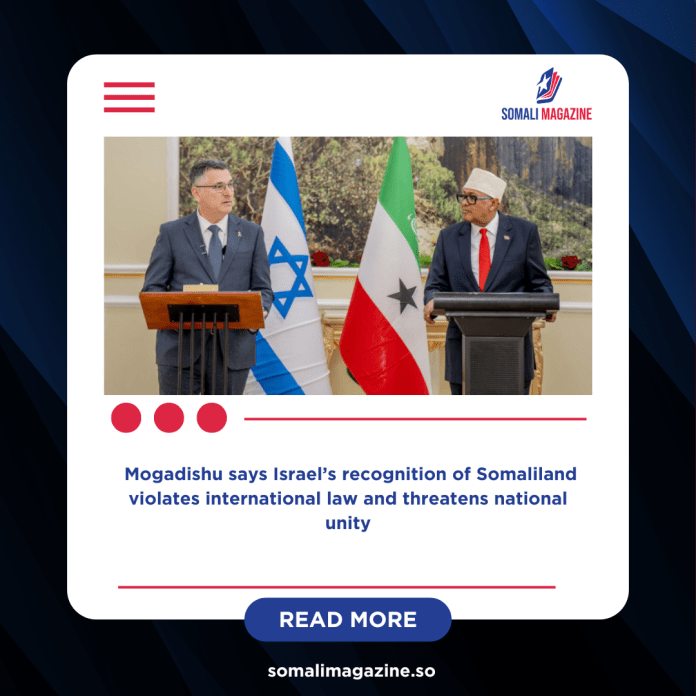
Somalia’s federal government has strongly condemned the visit by Israeli Foreign Minister Gideon Saar to Hargeisa, calling it an illegal and unauthorized act that violates the country’s sovereignty, territorial integrity, and political unity. In a statement released on Tuesday, the Ministry of Foreign Affairs and International Cooperation said the visit amounted to unacceptable interference in Somalia’s internal affairs and disregarded international law.
The government emphasized that Hargeisa is an inseparable part of Somalia’s internationally recognized territory. According to the ministry, any official engagement or presence by a foreign government within Somali territory without the clear consent of the Federal Government of Somalia is unlawful and has no legal standing. The statement stressed that such actions are considered null and void and cannot produce any valid political or legal consequences.
Somalia accused Israel of breaching key principles of international law, including respect for sovereignty, territorial integrity, and non-interference in the internal affairs of states. The ministry cited the United Nations Charter, the Constitutive Act of the African Union, and established international norms as frameworks that Israel’s actions allegedly violate. It warned that ignoring these principles threatens regional stability and undermines the rules-based international order.
The government called on Israel to immediately stop what it described as actions that weaken Somalia’s unity. It urged Israeli authorities to fully respect Somalia’s status as a sovereign member of the United Nations with internationally recognized borders. Somalia also appealed to major international and regional bodies, including the United Nations, the African Union, the League of Arab States, and the Organization of Islamic Cooperation, to clearly and publicly reaffirm their support for Somalia’s sovereignty and territorial integrity.
While reaffirming its commitment to peaceful engagement and constructive diplomacy with the international community, Somalia made it clear that it will not remain passive. The statement noted that the government reserves the right to take all necessary diplomatic and legal steps to protect the country’s unity and territorial integrity if such actions continue.
The controversy follows Saar’s arrival in Hargeisa, where he held talks with Somaliland President Abdirahman Mohamed Abdullahi. The visit marked the first time an Israeli foreign minister has made an official trip to Somaliland, coming shortly after Israel announced its recognition of Somaliland as an independent state. Israel’s decision has been described as unprecedented, making it the first country to formally recognize Somaliland since it declared independence from Somalia in 1991 after the collapse of the central government.
Somaliland’s leadership welcomed the recognition and the high-level visit, with President Abdullahi describing it as a historic moment for the region. Somaliland has operated with its own government, security forces, and institutions for more than three decades, though it has not previously received formal international recognition.
Somalia’s federal government, however, has firmly rejected both the recognition and the visit. Mogadishu views Somaliland as an integral part of the country and considers any attempt to recognize it as a direct challenge to Somalia’s sovereignty. Officials argue that recognizing Somaliland outside a negotiated and lawful process undermines Somalia’s efforts to rebuild national unity after years of conflict.
The issue has drawn concern from several regional and international actors, who have warned that Israel’s move could increase tensions in the Horn of Africa. Critics say the decision risks setting a dangerous precedent and could encourage further fragmentation in a region already facing political instability, security challenges, and humanitarian pressures.
As diplomatic reactions continue to unfold, Somalia insists that its territorial integrity is non-negotiable and that any engagement with regions within its borders must go through the federal government. The government has signaled that it expects the international community to uphold long-standing principles of international law and avoid actions that could further destabilize the region.