Facebook

Twitter (X)

Instagram

Somali Magazine - People's Magazine
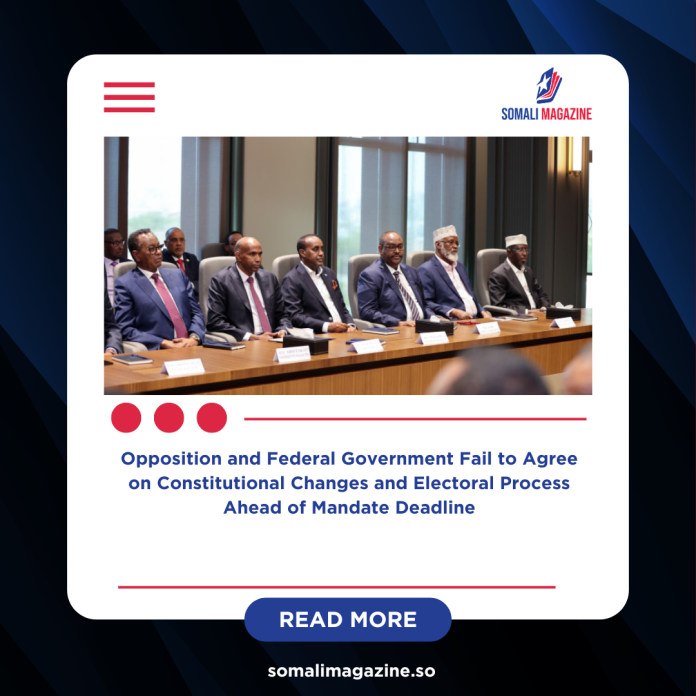
High-level talks between Somalia’s federal government and the opposition-aligned Somali Future Council have ended without an agreement, deepening political uncertainty as the country approaches a critical deadline. The negotiations, which took place over several days at the Presidential Palace in Mogadishu, focused mainly on elections and proposed constitutional reforms. With the mandate of federal institutions set to expire in about three months, the failure to reach a deal has raised concerns about the country’s political stability.
In a statement released on Monday, the Somali Future Council said it joined the talks with the aim of preventing political instability and ensuring that elections are held on time through a negotiated agreement. The council said it wanted a clear and mutually agreed electoral process before the current term of federal institutions ends. However, it accused the federal government of continuing with constitutional amendments without broader political agreement and public consultation.
The opposition group also claimed that more than 50 members of parliament have been blocked from attending parliamentary sessions. It further alleged that some of its members have faced intimidation and security pressure, alongside what it described as smear campaigns in the media. These accusations have added to tensions between the two sides.
At the heart of the dispute is the 2012 Provisional Constitution, which the opposition insists remains the country’s main legal framework. The council argues that any changes to the constitution must be based on national consensus and involve genuine public participation. It also emphasized the need to protect the balance of powers between the federal government and the member states. The federal government, on the other hand, has indicated that the constitutional review process will continue.
Elections at the state level have also become a major point of disagreement. The Somali Future Council said that upcoming elections in Galmudug, Hirshabelle, and Southwest should be conducted according to existing state constitutions and in line with federal principles. The council has continued to push for indirect elections in these states, similar to the models recently used in Puntland and Jubbaland.
President Hassan Sheikh Mohamud, however, has expressed his support for transitioning toward a one-person, one-vote electoral system. He has also stated that the responsibility for organizing state elections lies with the leadership structures of each federal member state. This difference in approach has made it difficult for both sides to find common ground.
Another major issue in the talks was the demand for a political agreement before April 14 on how federal parliamentary elections will be conducted. The opposition called for a transparent and inclusive electoral model, with clear rules and timelines agreed upon by all stakeholders. The government has maintained that direct elections represent the country’s long-term goal and preferred direction.
In its statement, the Somali Future Council said it would not accept what it described as a constitutional amendment carried out without consensus, a snap election, or an extension of the current term. The council framed its position as a defense of the constitution, federalism, and negotiated elections.
Despite the breakdown in talks, the council said it remains open to meaningful dialogue aimed at reaching an agreement before the constitutional mandates expire. It also called for a halt to what it described as unilateral constitutional changes.
The situation reflects the complex political landscape in Somalia, where trust between key actors remains fragile. Jubbaland President Ahmed Mohamed Islam Madobe, who is part of the council, returned to Kismayo after the announcement, highlighting the sensitive nature of the discussions.
Although the federal government has not released detailed comments on the outcome, it has suggested that further engagement is still possible. As the deadline approaches, many observers believe that renewed dialogue will be crucial to avoid a deeper political crisis and ensure a peaceful and agreed path toward elections.